Chapter 6 — Sediments and Sedimentary Rocks
Sedimentary rock is where most civil engineering happens. It covers about three-quarters of the continental surface, it hosts most aquifers, and its bedding planes are the commonest planes of weakness an engineer will meet.
6.1 Clastic sedimentary rocks
Formed from fragments of pre-existing rock, classified by grain size:
- Gravel / conglomerate / breccia — > 2 mm
- Sand / sandstone — 0.063–2 mm
- Silt / siltstone — 0.004–0.063 mm
- Clay / mudstone / shale — < 0.004 mm
Beyond grain size, three properties control behaviour: sorting, rounding and cementation. A well-sorted, well-cemented sandstone is a good foundation; a poorly sorted, weakly cemented mudstone is not.
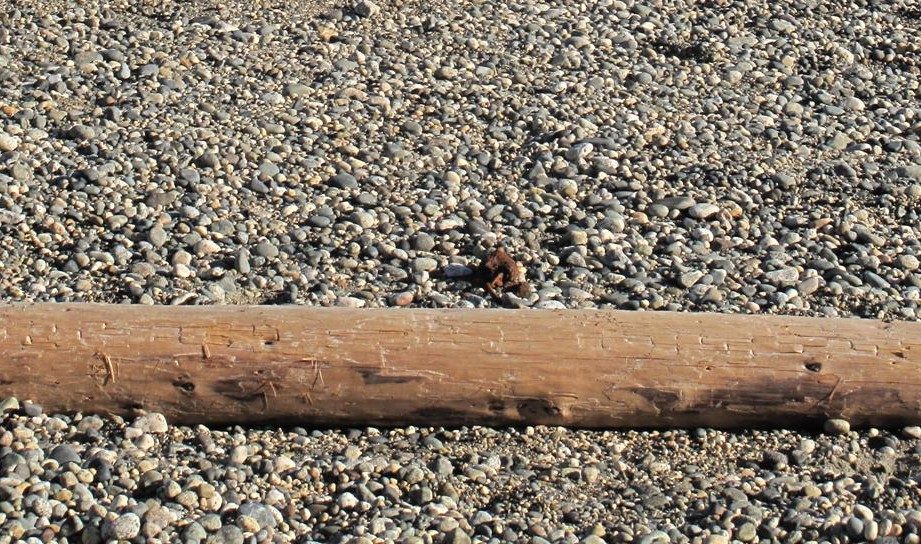
Figure. Pebbles on an ocean beach at Sechelt, B.C. Grain size, sorting and rounding — the properties read off a borehole log — begin here. © Steven Earle, CC BY 4.0 — Physical Geology, 2nd ed., Fig. 6.1.1.
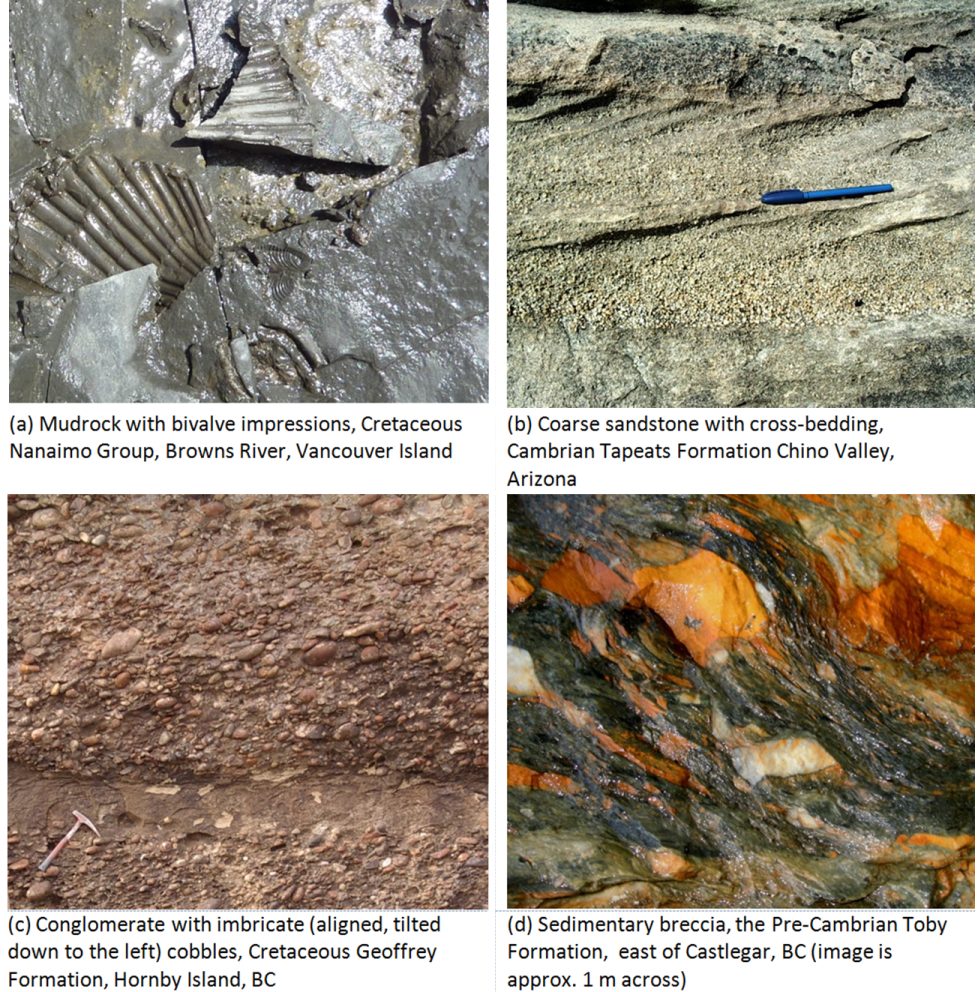
Figure. Examples of clastic sedimentary rocks. Texture and degree of cementation vary enormously, and they are the dominant control on strength and deformability. © Steven Earle, CC BY 4.0 — Physical Geology, 2nd ed., Fig. 6.1.8.
6.2 Chemical and organic sedimentary rocks
Precipitated from solution or built by organisms — limestone, dolomite, chert, evaporites and coal. Limestone is the critical one for foundations, because it dissolves.
6.3 Depositional environments and bedding
Sediment is deposited in environments (fluvial, lacustrine, marine, deltaic, aeolian, glacial) that leave characteristic structures: bedding, cross-bedding, graded bedding, ripple marks, mud cracks. These are not decoration — they tell the engineer how the deposit varies laterally and where the weak layers are.
Key points for the geotechnical engineer
- Grain size alone does not classify a soil — sorting, rounding and cementation matter just as much.
- Bedding planes are planes of weakness, and their dip relative to a cut or foundation governs stability.
- Limestone dissolves — expect karst, cavities and erratic groundwater.
- Depositional environment predicts variability: a delta is far less uniform than an aeolian sand.
Terminology
| English | Vietnamese |
|---|---|
| clastic | mảnh vụn |
| sandstone / mudstone / shale | cát kết / bột kết / sét kết |
| limestone / dolomite | đá vôi / đôlômit |
| sorting / rounding | độ chọn lọc / độ mài tròn |
| cementation | xi măng hoá (gắn kết) |
| bedding plane | mặt phân lớp |
| cross-bedding | phân lớp xiên |
Digest of Chapter 6, Physical Geology – 2nd Edition, by Steven Earle (CC BY 4.0).