Chapter 4 — Shallow Foundations: Settlement
4.1 Why settlement usually governs
For most structures on good ground, bearing capacity is not the controlling criterion — settlement is. A footing can be far from shear failure yet still settle enough to crack finishes, distort frames, or misalign machinery. Design therefore computes settlement and compares it with the tolerable movement for the structure.
4.2 The three components of settlement
Total settlement has three parts:
- Immediate (elastic) settlement — occurs as the load is applied, from elastic compression and lateral deformation of the soil. Significant in sands and unsaturated soils.
- Primary consolidation settlement — time-dependent drainage and volume change in saturated fine-grained soils, governed by Terzaghi's one-dimensional consolidation theory. Can take months to years.
- Secondary (creep) settlement — continued volume change at constant effective stress, especially in organic and soft clays.
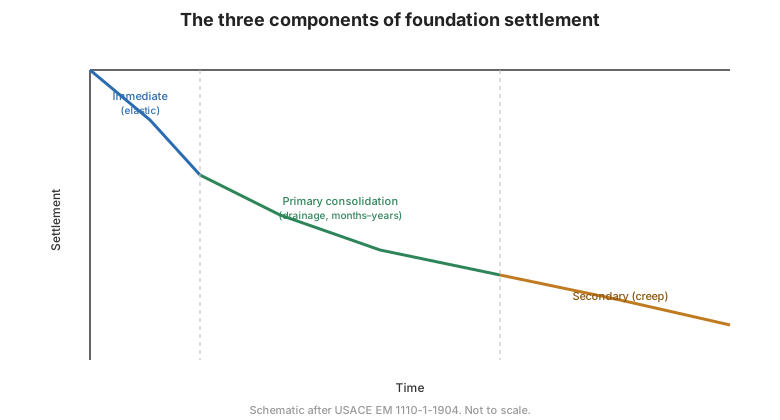
Figure. The three components of foundation settlement — immediate, primary consolidation, and secondary — accumulate over time (after USACE EM 1110-1-1904).
4.3 Immediate settlement
Immediate settlement is computed from elastic theory:
where \(q\) is the applied pressure, \(B\) the footing width, \(E\) and \(\nu\) the soil's elastic modulus and Poisson's ratio, and \(I_s\) an influence factor depending on footing shape and rigidity. In sands, \(E\) is often estimated from SPT or CPT correlations.
4.4 Primary consolidation settlement
For a normally consolidated clay:
where \(C_c\) is the compression index, \(H\) the layer thickness, \(e_0\) the initial void ratio, \(\sigma'_{v0}\) the initial effective stress, and \(\Delta\sigma\) the stress increase. For over-consolidated clays the recompression index \(C_r\) is used up to the preconsolidation pressure. Time rate is governed by the coefficient of consolidation \(c_v\).
4.5 Settlement of granular soils
In sands, consolidation is essentially immediate, and settlement is estimated from empirical correlations with SPT \(N\), CPT tip resistance, or plate load tests, with corrections for footing width and water table. Because sands are notoriously variable, these estimates carry wide uncertainty.
4.6 Tolerable movement and differential settlement
Design is governed not by absolute settlement but by:
- total settlement — must not impair the structure's function;
- differential settlement — the difference between adjacent points, which causes distortion, is usually the critical measure;
- angular distortion — differential settlement divided by the span between points.
Limits depend on the structure type (buildings, bridges, machinery) and are given in the design manuals and codes.
4.7 Key takeaways
- Settlement, not bearing capacity, usually governs shallow-foundation design.
- Total settlement = immediate + primary consolidation + secondary.
- Use elastic theory for immediate, consolidation theory for clays, empirical correlations for sands.
- Differential settlement and angular distortion are the real serviceability criteria.
- Monitor actual settlement with settlement platforms and extensometers (see the FHWA reference).