Chapter 8 — Measurement of Deformation
8.1 Deformation is the visible consequence
Most geotechnical failures announce themselves as movement. Deformation monitoring detects it — at the surface and, critically, deep underground where the eye cannot see.
8.2 Extensometers — measuring movement at depth
Extensometers measure relative displacement between an anchor and a reference, revealing settlement, heave, or separation at depth:
- Rod extensometers — rigid rods to anchors; simple, robust.
- Magnetic extensometers — magnetic rings on a access tube; multiple depths.
- Wire (sonic) extensometers — remote reading; good for long intervals.
- Multi-point borehole (MPBX) — several anchors in one borehole.
8.3 Inclinometers — detecting shear
Inclinometers measure lateral displacement versus depth, revealing the location and magnitude of a shear plane:
- Probe (traversing) inclinometers — a probe lowered down a casing.
- In-place (fixed) inclinometers — sensors fixed in the casing for automated monitoring.
Casing installation (verticality, grouting) determines data quality.
8.4 Tiltmeters, settlement, convergence, crackmeters
- Tiltmeters — rotation of a surface or structure.
- Settlement systems — liquid, magnetic, or tape; measure vertical movement over areas (e.g., embankments, foundations).
- Convergence — shortening between points in a tunnel or excavation.
- Crackmeters — opening of joints, cracks, or joints in structures.
8.5 Choosing the right tool
The choice depends on whether movement is vertical or lateral, surface or internal, slow or fast, and whether automation is needed. Often several are combined: an MPBX plus an inclinometer in the same borehole is a powerful combination.
Depth matters
Surface survey alone misses internal shear. Where a deep failure surface is credible, pair surface monitoring with borehole instruments along that surface.
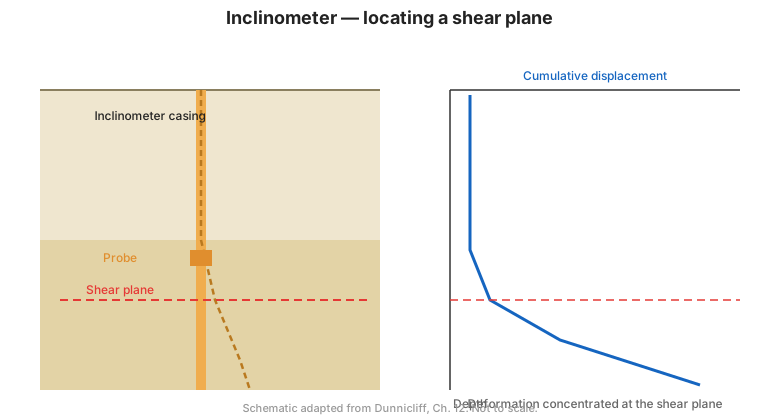
Figure. Inclinometer. A probe (or in-place array) in a casing measures lateral displacement with depth and locates the shear plane (Dunnicliff, Ch. 12).
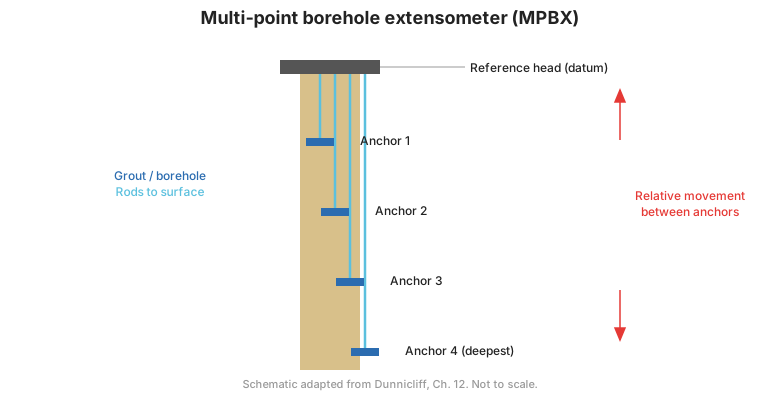
Figure. Multi-point borehole extensometer (MPBX). Anchors at several depths and rods to a reference head reveal settlement or separation at depth (Dunnicliff, Ch. 12).
8.6 Key takeaways
- Deformation is the usual pre-failure signal; measure it surface and deep.
- Extensometers reveal movement at depth; inclinometers locate shear planes.
- Tilt, settlement, convergence, and crackmeters cover the remaining modes.
- Combine instruments to catch both surface and internal movement.