Chapter 11 — Calibration & Maintenance
11.1 Calibration: the reference point
A sensor's reading is meaningless without a known relationship between its output and the physical quantity. Calibration establishes and maintains that relationship.
11.2 Factory and field calibration
- Factory calibration provides the as-delivered conversion and a certificate of traceability.
- Field calibration / verification confirms the instrument still performs after transport, installation, and exposure — because field conditions shift the relationship.
Periodic re-calibration (or at least verification against a reference) catches drift before it corrupts the record.
11.3 Maintenance schedules
A maintenance plan addresses:
- Readout units and dataloggers — function, clock, power.
- Cables and connectors — continuity, water ingress, rodent damage.
- Sensor zero and span — checked against manual or reference readings.
- Environmental protection — UV, corrosion, freezing.
11.4 Cold-weather guidelines
Freezing is a major cause of data loss:
- Bury or heat cables and sensors where needed.
- Use antifreeze or heated enclosures for standpipes and readouts.
- Document a seasonal plan, including safe shutdown and fallback to manual reads.
11.5 Documentation
Every calibration and maintenance action is recorded: date, method, result, person, and any change to conversion factors. This preserves the data's defensibility over the instrument's life.
Drift is silent
An uncalibrated sensor rarely fails loudly; it drifts quietly, corrupting trends until someone notices a physically impossible reading. Schedule verification; don't wait for the impossible number.
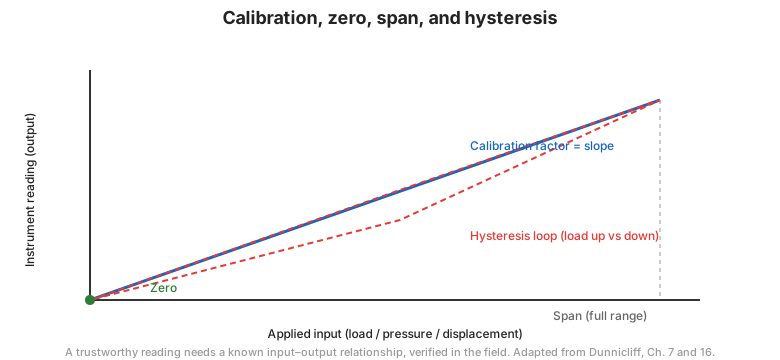
Figure. Calibration. The input-output relationship (slope = calibration factor), with zero, span, and hysteresis (Dunnicliff, Ch. 7 and 16).
11.6 Key takeaways
- Calibration ties output to physical quantity; verify it in the field.
- Maintain on a schedule: readouts, cables, zero, environment.
- Plan explicitly for freezing and seasonal effects.
- Record every calibration and maintenance action.