Chapter 11 — Instrumentation for Rock Slopes
11.1 Introduction
Rock slopes fail along discontinuities — joints, bedding planes, and faults — rather than through intact rock. Instrumentation for rock slopes therefore focuses on the movement of discrete blocks and on the water pressures acting on the discontinuities that could trigger sliding.
11.2 Cut slopes in rock
General role. Instrumentation detects block movement and the water pressures driving it, so that support or drainage can be adjusted.
Principal geotechnical questions:
- Are individual blocks moving, and how fast?
- What water pressures act on the discontinuities?
- Is the support (bolts, anchors, mesh) performing as intended?
Suitable instruments (Table 11-1) typically include: inclinometers and extensometers (block movement), crack/block gages (relative movement of blocks), piezometers (joint water pressure), load cells (anchor/bolt loads), and survey.
11.3 Landslides in rock
General role. Instrumentation characterizes the geometry and rate of a rock slide and the pore pressures controlling it, to guide stabilization and verify its effectiveness.
Principal geotechnical questions:
- How deep and how fast is the slide?
- What joint water pressures drive it?
- Is the stabilization (anchors, drainage) working?
Suitable instruments (Table 11-2) typically include: inclinometers and TDR (shear zone and rate), piezometers (joint water pressure), extensometers, load cells on anchors, and rain gauges.
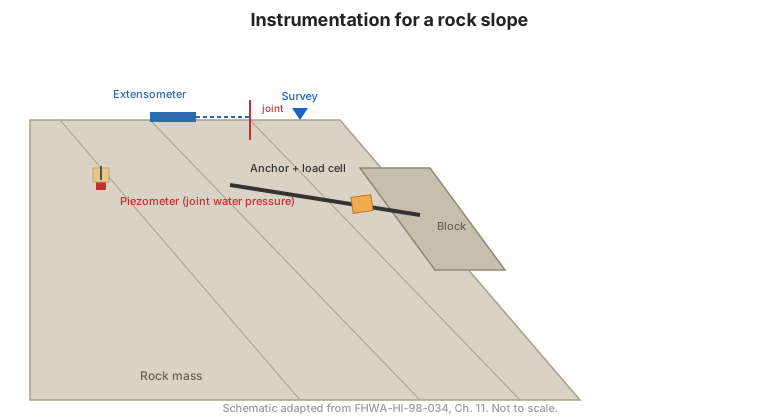
Figure. Instrumentation for a rock slope: extensometers and inclinometers to detect block movement, piezometers to measure joint water pressure, load cells on anchors, and surface survey (after FHWA-HI-98-034, Ch. 11).
11.4 Key takeaways
- Rock slopes fail along discontinuities — instrument the blocks, not the intact rock.
- Joint water pressure is the key driving variable; measure it with piezometers.
- Extensometers, crack gages, and survey capture block movement.
- Load cells on anchors and bolts confirm the support is carrying load.