Chapter 3 — Intrusive Igneous Rocks
Igneous rock forms when molten material cools and crystallises. Where it cools decides its texture, and therefore much of its engineering behaviour.
3.1 The rock cycle
Rock is not permanent. Igneous rock is weathered and eroded into sediment; sediment is buried and lithified into sedimentary rock; heat and pressure turn either into metamorphic rock; and any of them can be melted again. The cycle is why the soil above a rock and the rock itself can have completely different origins.
3.2 Intrusive versus extrusive
- Intrusive (plutonic) — magma solidifies underground. Slow cooling → coarse, interlocking crystals (granite, diorite, gabbro). Strong when intact; the joints, not the crystals, control the mass.
- Extrusive (volcanic) — lava solidifies at the surface. Fast cooling → fine-grained or glassy (basalt, andesite, rhyolite), often with vesicles and flow structures.
3.3 Intrusive bodies
Batholiths, stocks, dykes and sills. A dyke cuts across existing layers; a sill lies parallel to them. Both are discontinuities in the ground model, and both can be either stronger or weaker than the host rock.
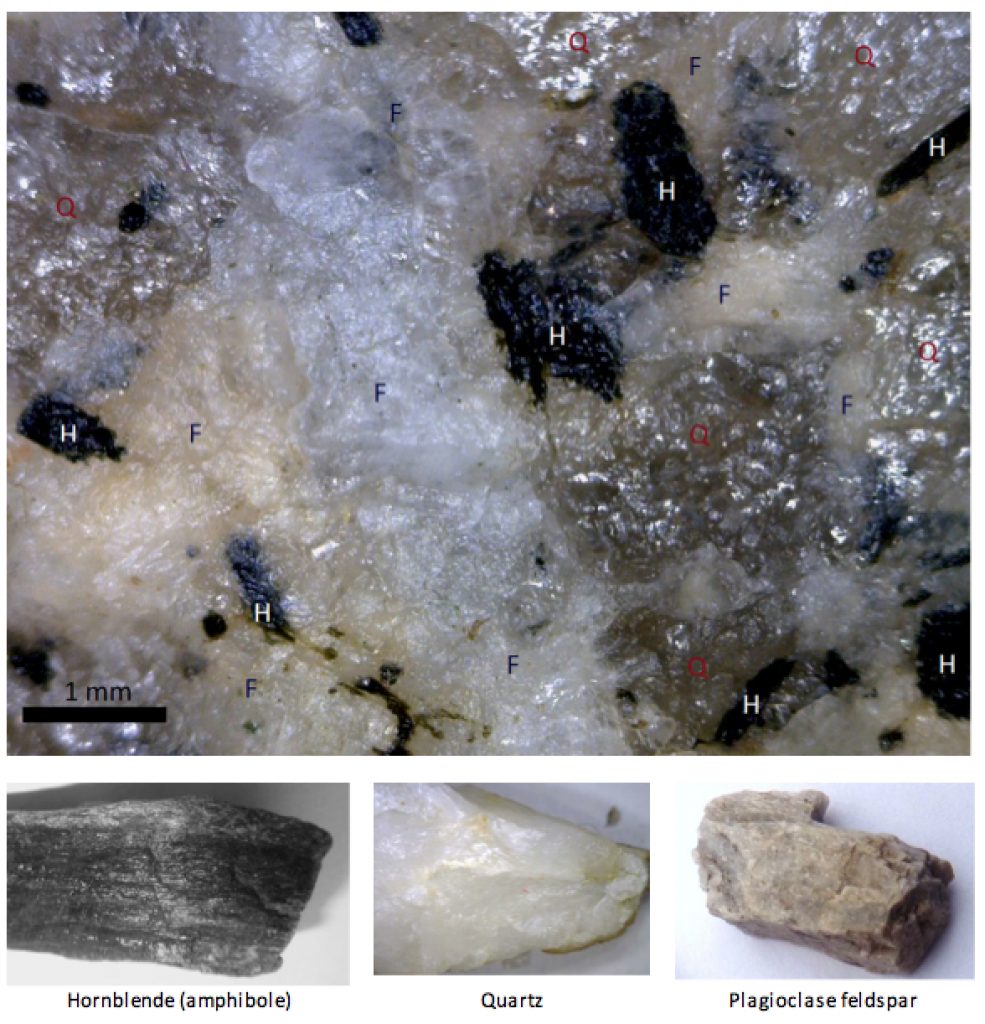
Figure. Coarse, interlocking crystals in granite — the signature of slow cooling at depth. A dyke or sill of this rock intruded into a weaker host becomes a structural feature the design must account for. © Steven Earle, CC BY 4.0 — Physical Geology, 2nd ed., Fig. 1.4.2.
Key points for the geotechnical engineer
- Texture tells the cooling history — and coarse igneous rock tends to be strong but joint-controlled.
- Intrusive contacts are discontinuities. A dyke or sill is a plane where properties change abruptly, and often a plane of weakness.
- Extrusive rock can be highly porous or fractured — vesicular basalt and fractured volcanic rock can be surprisingly permeable.
- Weathered basalt becomes laterite, one of the characteristic problem soils of Vietnam's Central Highlands and Southeast.
Terminology
| English | Vietnamese |
|---|---|
| intrusive / extrusive | xâm nhập / phun trào |
| magma / lava | magma / dung nham |
| granite / basalt | granit / badan |
| dyke / sill | mạch cắt tầng / mạch nằm ngang |
| batholith | batholit (thể xâm nhập lớn) |
| laterite | đá ong / laterit |
Digest of Chapter 3, Physical Geology – 2nd Edition, by Steven Earle (CC BY 4.0).