Chapter 11 — Earthquakes
An earthquake is the rapid release of accumulated elastic strain along a fault, radiating seismic waves. For the engineer, the questions are: how big, how far, and how does the ground respond?
11.1 Earthquake basics
- Focus — where rupture begins, inside the Earth.
- Epicentre — the point on the surface directly above the focus.
- Fault — the fracture along which displacement occurs. An active fault is one that has moved in recent geological time and may move again.
Figure. A fault (white dashed line) in intrusive rock on Quadra Island, B.C., with about 10 cm of right-lateral offset. A fault is a plane of already-broken rock. © Steven Earle, CC BY 4.0 — Physical Geology, 2nd ed., Fig. 12.3.4.
11.2 Measuring earthquakes
- Magnitude \(M\) — a single number for the size of the event, from the amplitude of ground motion or the seismic moment.
- Intensity \(I\) — a description of the effects at a place; varies with distance, ground conditions and building type.
Magnitude is a property of the earthquake; intensity is a property of the site.
11.3 Earthquakes and plate tectonics
Most earthquakes occur at plate boundaries — subduction zones, mid-ocean ridges and transform faults — but intraplate earthquakes occur too, and Vietnam's seismicity (notably the northwest, along the Red River and Lai Chau–Dien Bien fault zones, and parts of the Central Highlands) is of that type.
11.4 Consequences and secondary hazards
Beyond direct shaking, earthquakes trigger landslides, liquefaction, ground subsidence and tsunami. Saturation followed by shaking is the classic compound trigger.
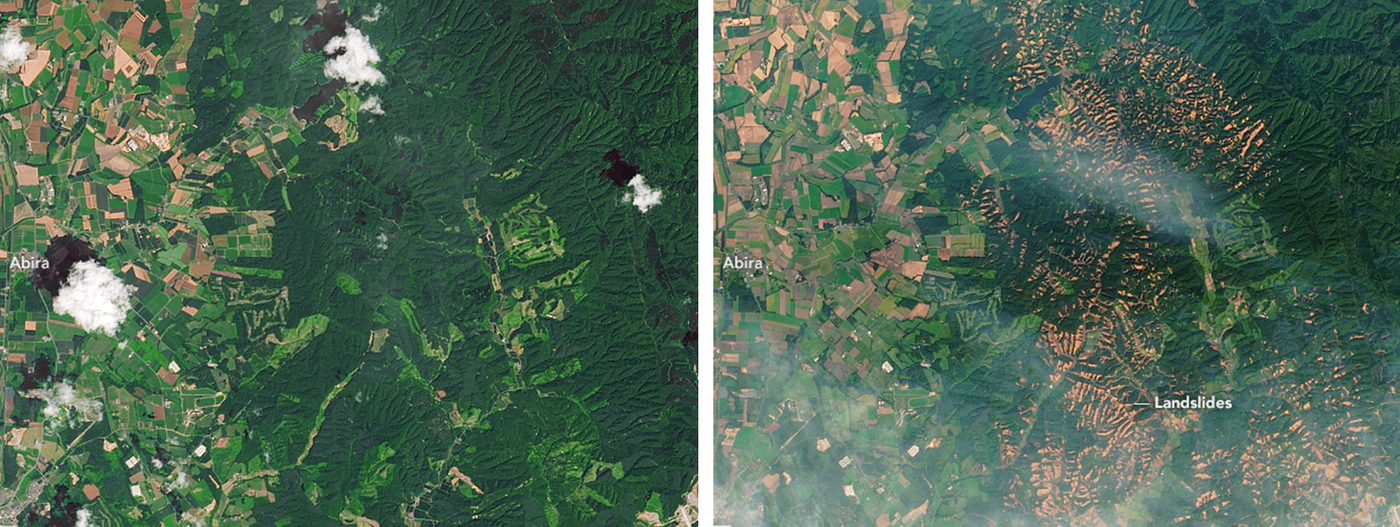
Figure. Slope failures near Sapporo, Japan, after a typhoon (4 Sept 2018) and an earthquake (6 Sept 2018). Before (July 2017, left) and after (September 2018, right) Landsat 8 images. 'Landslides in Hokkaido' by Lauren Dauphin, NASA Earth Observatory (public domain) — Physical Geology, 2nd ed., Fig. 15.1.7.
Key points for the geotechnical engineer
- Magnitude ≠ intensity. Design needs the ground motion at the site, not the magnitude of the event.
- Site conditions dominate the response. Soft soils amplify shaking; rock does not.
- Liquefaction requires saturation — assess it wherever loose saturated sand lies below the water table.
- Rain + earthquake is the most damaging landslide trigger combination.
- Vietnam is not aseismic — seismic design is required in the northwest and parts of the Central Highlands.
Terminology
| English | Vietnamese |
|---|---|
| earthquake | động đất |
| focus / epicentre | chấn tiêu / chấn tâm |
| fault / active fault | đứt gãy / đứt gãy hoạt động |
| magnitude / intensity | độ lớn (chấn cấp) / cường độ |
| seismic zoning | phân vùng địa chấn |
| liquefaction | hoá lỏng đất nền |
| amplification | khuếch đại (nền đất) |
Digest of Chapter 11, Physical Geology – 2nd Edition, by Steven Earle (CC BY 4.0).