Chapter 7 — Metamorphism and Metamorphic Rocks
Metamorphism changes rock in the solid state, under heat and pressure, without melting it. The result is a rock with a new fabric — and that fabric is the most important single cause of anisotropy in rock engineering.
7.1 Controls on metamorphism
The agents are heat, pressure (both confining and directed), and chemically active fluids. Increasing grade produces a sequence of minerals, which is why metamorphic rocks can be mapped by their mineral assemblage.
7.2 Foliation
Directed pressure aligns platy minerals (mica, chlorite) into foliation — a planar fabric. Foliation is the defining feature of slate, schist and gneiss.
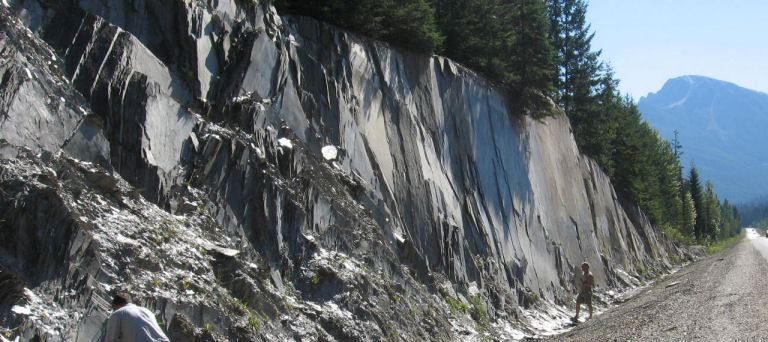
Figure. Slate at a road cut in the Columbia Mountains, B.C., peeling along its foliation planes. The directional fabric — not the intact strength — governs how the cut stands. © Steven Earle, CC BY 4.0 — Physical Geology, 2nd ed., Fig. 5.1.2.
7.3 Types of metamorphism
- Regional — large areas, associated with mountain building and plate collision; produces foliated rock.
- Contact — local, around an igneous intrusion; produces non-foliated rock (hornfels, marble, quartzite).
- Hydrothermal — alteration by hot fluids, often producing weak, clay-rich zones.
Key points for the geotechnical engineer
- Foliation creates extreme anisotropy. Schist and slate are far weaker across the foliation than along it — and the foliation orientation decides slope and foundation behaviour.
- Marble and quartzite are strong and isotropic when fresh, but can be karstic (marble) or intensely jointed.
- Hydrothermal alteration produces weak zones — the same process that makes a rock mass locally unbuildable.
- Metamorphic terrain usually means steep slopes, deep weathering and structural complexity.
Terminology
| English | Vietnamese |
|---|---|
| metamorphism | biến chất |
| foliation | cấu tạo phiến |
| slate / schist / gneiss | đá phiến sét / đá phiến / gơnai |
| marble / quartzite | đá hoa / quaczit |
| anisotropy | tính dị hướng |
| hydrothermal alteration | biến đổi nhiệt dịch |
Digest of Chapter 7, Physical Geology – 2nd Edition, by Steven Earle (CC BY 4.0).