Chapter 5 — Instrument Families for Dam Monitoring
5.1 A menu of measurements
This chapter surveys the instrument families used to monitor dams. Later chapters go deeper on the most safety-critical ones. For detailed installation procedures, see the Dunnicliff and FHWA manuals in this knowledge base.
5.2 Measurement categories
| Category | What it measures | Representative instruments |
|---|---|---|
| Water level / reservoir | Pool elevation, stage | Staff gauges, pressure transducers, float gauges |
| Pore pressure / uplift | Water pressure in soil/rock/concrete | Vibrating-wire, pneumatic, standpipe, hydraulic piezometers |
| Seepage / leakage | Flow quantity & quality | Weirs, tipping buckets, turbidity sensors, observations |
| Deformation — surface | Movement of the dam surface | Survey monuments, GNSS, total station |
| Deformation — internal | Movement inside embankment/foundation | Inclinometers, extensometers, settlement systems, SAA |
| Structural | Cracks, joint opening, load | Crackmeters, joint meters, load cells, strain gauges |
| Environmental | Rainfall, temperature, pore-air | Rain gauges, thermistors, barometers |
| Concrete / aging | Distress, alkali, corrosion | Rebar corrosion probes, acoustic emission |
5.3 Sensor technologies
Instruments convert a physical quantity into a readable signal. Common technologies:
- Vibrating-wire (VW) — a tensioned wire whose frequency changes with strain; robust, drift-free, and the workhorse of modern dam monitoring.
- Pneumatic — gas pressure balances the measured pressure; useful where power or cables are impractical.
- Hydraulic — liquid-column pressure; simple and long-proven.
- Electrical/resistive & inductance — potentiometers, LVDTs, and strain gauges.
- Piezoelectric & MEMS — accelerometers, tiltmeters, and modern inertial sensors.
5.4 Manual vs. automated
- Manual instruments are read on site with a portable readout. Low cost, but limited frequency and exposure of personnel to hazardous conditions.
- Automated instruments feed dataloggers and telemetry, enabling high frequency, remote access, and alarms (Chapter 9).
5.5 Accuracy, resolution, and range
Three distinct concepts are often confused:
- Accuracy — closeness to the true value (calibration matters).
- Resolution — the smallest change the instrument can detect.
- Range — the span over which it remains valid.
A dam may need only moderate accuracy but high resolution to detect slow trends. Specify all three, and a realistic error budget.
5.6 Selecting a family
The choice follows the planning step: match the instrument to the indicator, location, available power, accessibility, expected life, and data system. Redundancy at the most critical locations is prudent — if the one piezometer that guards a failure mode fails, the program has a blind spot.
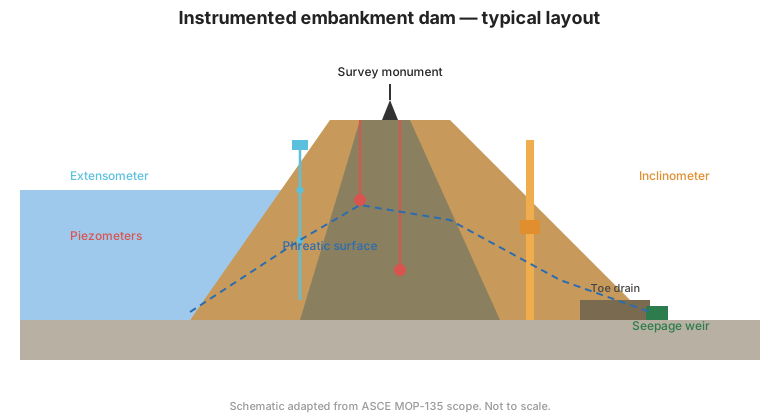
Figure. Typical instrument layout on an embankment dam: crest survey, piezometers, extensometer, inclinometer, toe drain, and seepage weir (ASCE MOP-135 scope).
5.7 Key takeaways
- Instruments fall into water level, pore pressure, seepage, deformation, structural, and environmental families.
- Vibrating-wire sensors are the modern workhorse; pneumatic and hydraulic remain useful.
- Distinguish accuracy, resolution, and range — trend detection often needs resolution most.
- Match the family to the planned indicator and environment; add redundancy at critical points.