Chapter 9 — Earth's Interior and Seismology
Almost everything known about the deep Earth comes from seismic waves. The same physics is the basis of every seismic method used in geotechnical investigation — so this chapter is both background and methodology.
9.1 Body waves
Two types of wave travel through the Earth's interior:
- P waves (primary) — compression waves. Fastest; travel through solids, liquids and gases.
- S waves (secondary) — shear waves. Slower; travel through solids only.
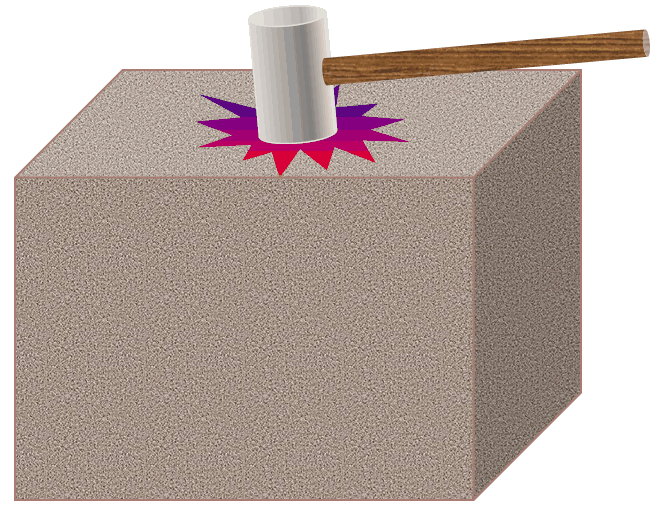
Figure. A hammer blow into a rock block generates seismic waves within it — the principle of cross-hole, down-hole and refraction seismic testing. © Steven Earle, CC BY 4.0 — Physical Geology, 2nd ed., Fig. 9.1.1.
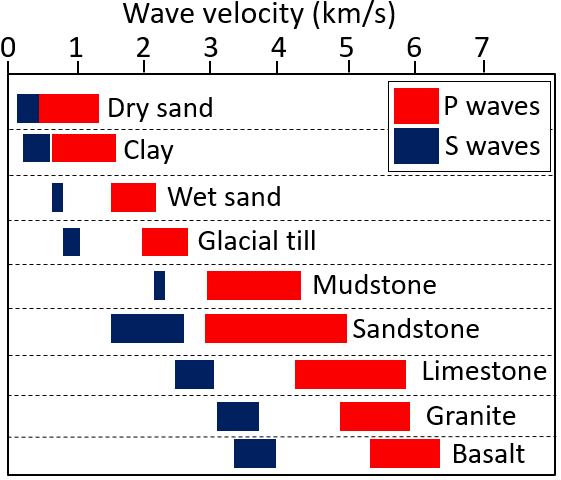
Figure. Typical P-wave (red) and S-wave (blue) velocities in sediments and solid crustal rock. The large contrast between soft sediment and rock is what makes seismic refraction a reliable tool for finding depth to bedrock. © Steven Earle, after the US Environmental Protection Agency (public domain) — Physical Geology, 2nd ed., Fig. 9.1.3.
9.2 Velocity and material properties
Wave velocity depends on elastic stiffness and density. Because stiffness generally increases with depth, velocity increases with depth — but it drops sharply wherever the material is weak, fractured, or partially molten. A local drop in velocity is an anomaly, and mapping anomalies is what seismic surveys do.
9.3 The layered Earth
- Crust — to about 30–40 km under continents, 5–10 km under oceans.
- Moho — the crust–mantle boundary, detected by the abrupt jump in wave velocity.
- Mantle — to 2 890 km; strong and dense.
- Core — an outer liquid part (S waves cannot pass) and a solid inner core.
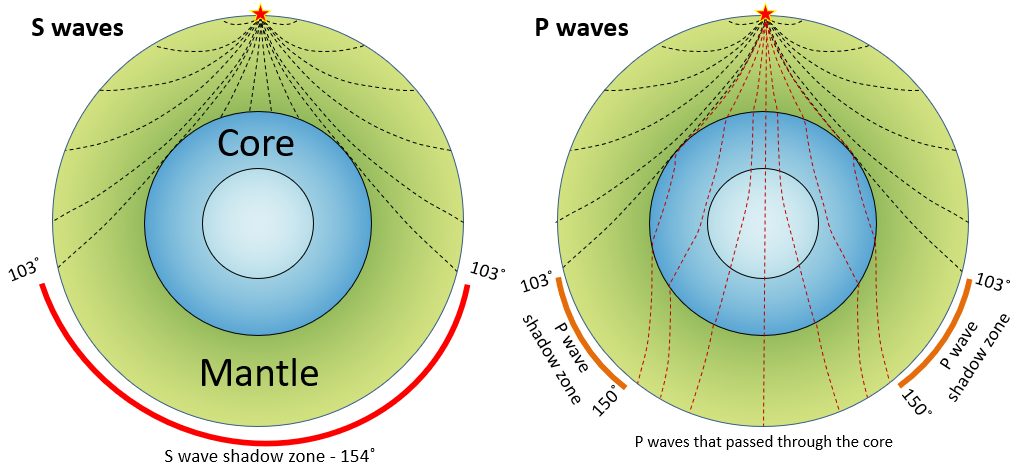
Figure. Propagation of seismic waves through the mantle and core. S waves are stopped at the core-mantle boundary, leaving an S-wave shadow on the far side of the Earth. © Steven Earle, CC BY 4.0 — Physical Geology, 2nd ed., Fig. 9.1.6.
Key points for the geotechnical engineer
- S-wave velocity is the key dynamic soil parameter used in seismic site response and liquefaction assessment.
- Velocity contrast = a detectable boundary. The sediment/rock contrast is what seismic refraction exploits to find depth to bedrock.
- S waves do not pass through liquid, which is why they can detect saturated, soft or liquefiable layers.
- The Moho is the deepest discontinuity — but the ones that matter are metres, not kilometres, below the foundation.
Terminology
| English | Vietnamese |
|---|---|
| P wave / S wave | sóng P / sóng S |
| seismic velocity | vận tốc địa chấn |
| refraction / cross-hole seismic | địa chấn khúc xạ / giữa các hố khoan |
| Moho (Mohorovičić discontinuity) | mặt Moho |
| anomaly | dị thường |
| shear-wave velocity (Vs) | vận tốc sóng cắt (Vs) |
Digest of Chapter 9, Physical Geology – 2nd Edition, by Steven Earle (CC BY 4.0).