Chapter 2 — Tailings Facilities and How They Fail
2.1 Tailings facility types
Tailings are deposited as a slurry and the supernatant water is recovered through a decant system. The embankment that retains the deposit is raised by one of several methods, which strongly influence safety:
- Downstream method — each raise is placed downstream of the previous one, producing a broad, stable cross-section with foundation support under most of the structure. Generally the most robust.
- Centerline method — raises are placed on the centerline; intermediate in risk.
- Upstream method — each raise is placed on the upstream (deposition) side, relying on the tailings beach for support. Highest risk: the embankment sits on the weakest, often loose, saturated material, and is prone to static and seismic liquefaction.
Alternative configurations include paddock / in-pit storage and thickened / paste / filtered tailings, which reduce free water and lower liquefaction risk.
2.2 The dominant failure modes
Understanding how tailings facilities fail focuses the monitoring program. The principal modes are:
- Static liquefaction of the embankment or deposit. Loose, saturated, contractive tailings lose strength under static loading (e.g., a raise, a rapid rise in phreatic surface, or a foundation weakness) and flow. This is the mechanism behind several of the worst historical failures.
- Seismic liquefaction. Cyclic shaking converts loose saturated tailings into a liquefied state, triggering flow sliding. Seismic regions demand special attention to liquefiable layers.
- Overtopping. Inadequate freeboard, extraordinary rainfall, pond mismanagement, or blocked decants let water overtop the embankment.
- Piping / internal erosion. Seepage erodes a channel through or under the embankment, often undetected until a blowout.
- Slope instability (static). Over-steep beaches or embankments fail by sliding, especially where pore pressure is high.
- Foundation failure. Weak or variable foundations (e.g., compressible soils,karst, or liquefiable layers) lead to settlement, cracking, or flow.
- Structural failure of appurtenant works. Decant towers, pipelines, and spillways can fail and compromise the whole system.
2.3 The chain to failure
Most catastrophic failures are not single events but chains: a predisposing condition (loose saturated tailings, high phreatic surface) plus a trigger (rainfall, rapid filling, earthquake) plus inadequate detection. Monitoring exists to break that chain — by revealing the predisposing condition early.
Upstream construction deserves special vigilance
Facilities using the upstream method carry the highest inherent risk and are the subject of global efforts to prohibit or strictly control them. Their surveillance programs should be the most intensive, with particular attention to pore pressure and beach geometry.
2.4 Linking failure modes to instruments
| Failure mode | Primary signals | Instruments |
|---|---|---|
| Static / seismic liquefaction | Rising pore pressure, low SPT/CPT resistance, settlement | Piezometers, inclinometers, survey, CPT |
| Overtopping | Loss of freeboard, high pond level | Survey, level gauges, rainfall |
| Piping | Uplift, muddy seepage, settlement | Piezometers, seepage weirs, visual |
| Slope instability | Movement, cracking | Survey, inclinometers, extensometers |
| Foundation failure | Differential settlement, tilt | Survey, piezometers, tiltmeters |
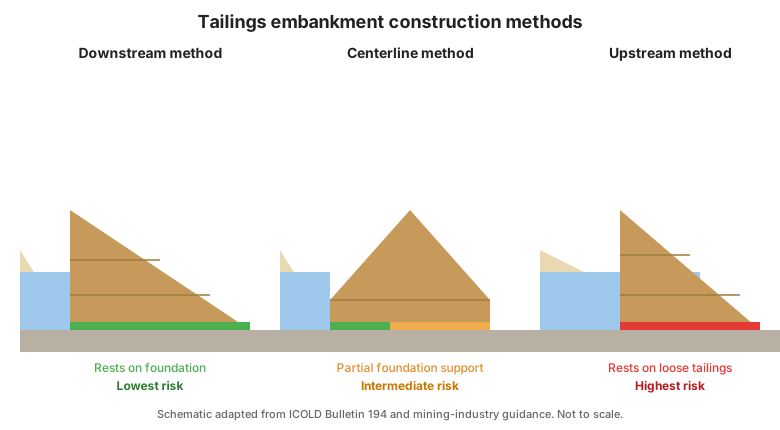
Figure. Tailings embankment construction methods. Downstream, centerline, and upstream raises - only the downstream method rests on the foundation; the upstream method sits on loose, saturated tailings and carries the highest risk (ICOLD Bulletin 194).
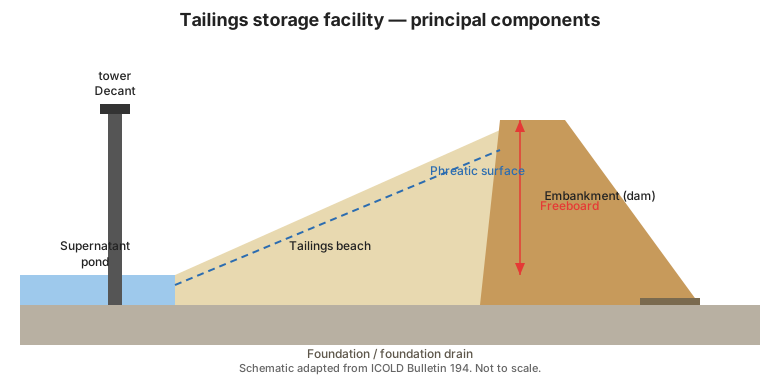
Figure. Principal components of a tailings storage facility: embankment, beach, supernatant pond, decant tower, phreatic surface, and freeboard (ICOLD Bulletin 194).
2.5 Key takeaways
- Construction method governs inherent risk; upstream is highest.
- Liquefaction (static and seismic) is the dominant catastrophic mechanism.
- Failures are chains of predisposition + trigger + late detection.
- Map every failure mode to specific instruments before designing the program.