Chapter 2 — Overview of Hardware for Groundwater Pressure
2.1 What a piezometer is
In this reference, a piezometer is a device sealed within the ground so that it responds only to groundwater pressure around itself and not to pressures at other elevations. Piezometers monitor pore-water pressure in soil and joint water pressure in rock. (The term pore-pressure cell is sometimes used as a synonym.) An observation well is a different instrument: it has no subsurface seals and therefore creates a vertical connection between strata.
Piezometer applications fall into two broad categories:
- Mapping the pattern of water flow — for example, monitoring subsurface flow during large-scale pumping tests to determine permeability in situ, or tracking long-term seepage in slopes.
- Providing an index of strength — pore pressure allows effective stress to be estimated (\(\sigma' = \sigma - u\)), and thus strength to be assessed. Examples include the strength along a potential failure plane behind a cut slope, and pore-pressure control during staged construction over soft clay foundations.
The difference between soil and rock piezometers is not the instrument but the installation: in soil, a short sand column (typically ~750 mm) is placed around the piezometer; in rock, the sand column is much longer to ensure it intersects a discontinuity.
2.2 Observation wells
An observation well is a perforated section of pipe attached to a riser, installed in a sand- or gravel-filled borehole. A surface seal prevents runoff from entering, and a vent in the cap lets water flow freely. The water level is found by sounding.
Appropriate applications are very limited. Because an observation well creates a vertical connection between strata, it is valid only in continuously permeable ground where groundwater pressure increases uniformly with depth — a condition that can rarely be assumed. In current practice they are frequently installed during site investigation "to define initial groundwater pressures," but the readings are often misleading. Observation wells should rarely be used for performance monitoring.
2.3 Open standpipe piezometers
The open standpipe (Casagrande) piezometer is a filter tip connected to a riser pipe, with the annular space sealed above the filter so that only the target zone is connected. It is reliable, has a long record of successful performance, and its seal integrity can be checked after installation with a falling-head test. It can be converted to a remote-reading instrument by inserting a pressure transducer.
Its great limitation is the long hydrodynamic time lag (Section 2.7). Other limitations: it can be damaged by construction equipment or by vertical compression of the surrounding soil; it can freeze if the piezometric level rises above the frost line; extending the standpipe through an embankment interrupts fill placement and causes inferior compaction; and the porous filter can plug with repeated inflow and outflow.
2.4 Pneumatic piezometers
A pneumatic piezometer uses a flexible diaphragm balanced by gas pressure supplied and returned through twin tubes. Advantages: short time lag, the calibrated part of the system stays accessible at the readout, minimum interference with construction, and no freezing problems. Limitations: readings are somewhat operator-dependent, and accuracy is reduced when read under a flowing-gas condition.
2.5 Vibrating-wire piezometers
A vibrating-wire (VW) piezometer measures the change in resonant frequency of a tensioned wire as a diaphragm deflects under water pressure. Advantages: easy to read, short time lag, minimum interference with construction, minimal lead-wire effects, no freezing problems, and ready connection to a datalogger for automated monitoring. Its principal limitation is that the need for lightning protection should be evaluated.
2.6 Multipoint piezometers
A multipoint piezometer places several sensors in one borehole to give detailed pressure-versus-depth measurements, with an unlimited number of measurement points and a calibrated part of the system accessible at the surface. The trade-off is a complex installation procedure, and typically only periodic manual readings.
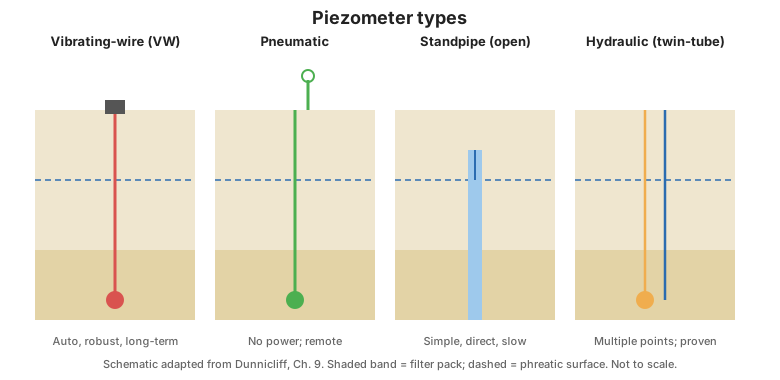
Figure. Common piezometer types compared: vibrating-wire, pneumatic, open standpipe, and twin-tube hydraulic (after FHWA-HI-98-034, Ch. 2).
2.7 Hydrodynamic time lag
The hydrodynamic time lag is the time for water to move through the filter and equalize pressure with the surrounding ground. It is governed by the instrument's volume-change flexibility relative to the permeability of the ground:
- A standpipe must admit a large volume of water to raise the column — so in low-permeability clay the lag can be weeks to months.
- A diaphragm instrument (pneumatic or VW) changes volume by only a tiny amount, so its lag is seconds to minutes.
This is why low-permeability ground demands a stiff-diaphragm instrument, and why a standpipe is only appropriate in relatively permeable soil.
2.8 Recommended instruments and miscellaneous issues
- Selection: use the table of advantages and limitations to match the instrument to the ground and to the required response speed.
- Filter type: the porous filter must be chosen so it does not clog and does not itself add lag.
- Granular bentonite seal above the piezometer, then grout above that seal, to isolate the measurement zone.
- Sounding hammer / probe: used to locate the water level in standpipes and observation wells.
Diaphragm piezometers read head, not elevation
A diaphragm piezometer reading indicates the head above the piezometer; the piezometer's own elevation must be measured or estimated if a piezometric elevation is required. All diaphragm piezometers (except vented types) are sensitive to barometric pressure changes.
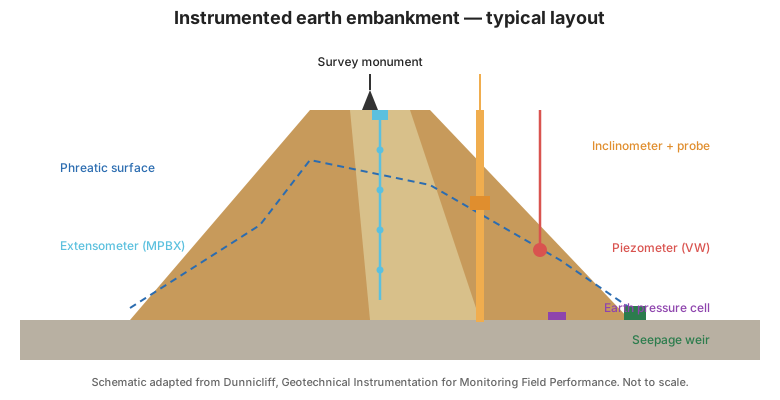
Figure. Typical borehole installation cross-section showing the filter zone, seal, and grout backfill that isolate a piezometer (after FHWA-HI-98-034, Ch. 2).
2.9 Key takeaways
- A piezometer must be sealed to respond only to its own zone.
- Observation wells create a vertical connection and should rarely be used for monitoring.
- Time lag is the deciding factor: standpipes are slow, diaphragm instruments are fast.
- VW piezometers are the default for automated, long-term monitoring — but plan lightning protection.
- Always record the piezometer elevation, and watch barometric effects.