Chapter 6 — Deep Foundations: Types & Load Transfer
6.1 When deep foundations are used
Deep foundations carry load to competent strata far below the surface, or develop capacity along their length through friction. They are used when:
- surface soils are too weak or compressible for shallow foundations;
- loads are very large;
- scour, uplift, or lateral loads must be resisted;
- settlement must be tightly controlled;
- expansive or collapsible soils make shallow foundations unreliable.
6.2 Pile classification
Piles are classified by material, installation method, and load-transfer mechanism:
- By material: timber, steel (H-piles, pipe piles, sheet piles), concrete (precast or cast-in-place), and composite.
- By installation: driven (displacement piles, which densify the soil), drilled/bored (non-displacement, which remove soil), and jetted or vibrated.
- By load transfer: end-bearing (tip rests on a hard stratum), friction (load carried by skin friction along the shaft), and combined.
6.3 How a pile carries load
A loaded pile mobilizes resistance in two places:
- End bearing at the toe, where the pile bears on or penetrates a stronger stratum; and
- Skin friction along the shaft, from the shear resistance between the pile and the soil.
The load is not uniform: it decreases with depth as the soil takes it up. At working load, both components mobilize, but their relative shares depend on the soil profile and the pile stiffness.
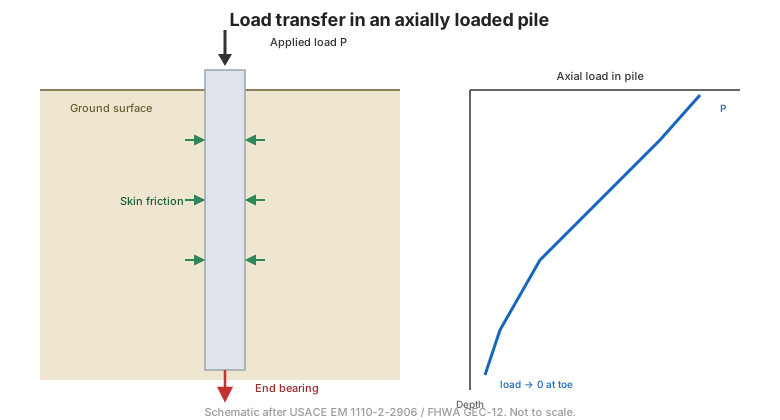
Figure. Load transfer in a pile: axial load decreases with depth as skin friction and end bearing mobilize; strain gages and telltales reveal the distribution (after USACE EM 1110-2-2906 / FHWA GEC-12).
6.4 Installation effects
Installation changes the soil around the pile:
- Driving displaces and densifies soil, increasing the effective stress and capacity in sands, but can cause heave and damage to adjacent structures.
- Drilling relieves stress and may leave a smear zone, reducing capacity, but causes less disturbance.
- Set-up (freeze) — driven piles in clay gain capacity with time as excess pore pressures dissipate.
These effects mean capacity is not a pure property of the soil — it depends on how the pile was installed.
6.5 Key takeaways
- Deep foundations are used for weak surface soils, large loads, scour, uplift, lateral loads, and settlement control.
- Classify piles by material, installation, and load transfer.
- A pile mobilizes end bearing + skin friction; load decreases with depth.
- Installation changes the soil — driving densifies, drilling relieves; set-up increases capacity over time.
- Instrument load tests to see the true distribution (Chapter 7).