Chapter 6 — Deep Foundation Analysis
Chapter VI treats the pile: how piles are classified, how a single pile carries load, what happens when the ground moves against the pile, how piles behave under lateral load and in groups, and how the group settles.
6.1 Basic concepts
6.1.1 Definition of a deep foundation / pile
A deep foundation (móng sâu) transfers load to deeper, stronger strata. The pile (móng cọc / cọc) is the dominant type.
6.1.2 Classification of piles
The handbook follows the French code DTU 13-2, which groups piles by how they are made and how they transfer load:
| Group | Type |
|---|---|
| 1 | Prefabricated piles — driven timber, steel, prestressed-concrete, driven tubular |
| 2 | Driven cast-in-place — tube driven then filled and withdrawn, or filled and left |
| 3 | Bored piles — plain, cased, slurry, auger, screw |
| 4 | Caissons (cọc giếng) |
| 5 | Pressed piles (cọc ép) — concrete and metal |
| 6 | Mini piles (cọc mini) |
Group 1, 2 and 5 are driven piles: they displace and compact the soil around them, so they mobilise skin friction well. But in very soft, structured soils the driving can remould the soil and reduce friction. Group 3 and 4 are bored/replacement piles: the bore relieves lateral stress, so the friction they mobilise is lower for the same nominal area.
6.2 Principles of pile analysis
6.2.1 Pile under vertical load
6.2.2 Pile under other external forces
6.3 Vertical-load behaviour in homogeneous ground
6.3.1 Why the analysis is complex
6.3.2 Basic concepts
6.3.3 Synthesis of experimental results
6.4 Mobilisation of resistance as the pile moves
6.4.1 A vertically loaded pile embedded in two layers
6.4.2 Progressive mobilisation of resistance with displacement
6.5 Practical calculation of single-pile capacity
The general form is the sum of the two components:
where \(Q_p\) is end-bearing and \(Q_f\) is skin friction.
6.5.1 The general formula
6.5.2 From soil-mechanics theory
6.5.3 From the SPT
6.5.4 From the CPT
6.5.5 From the Menard pressuremeter
6.5.6 From the pile-driving formula (PDT)
6.5.7 A single pile embedded in rock
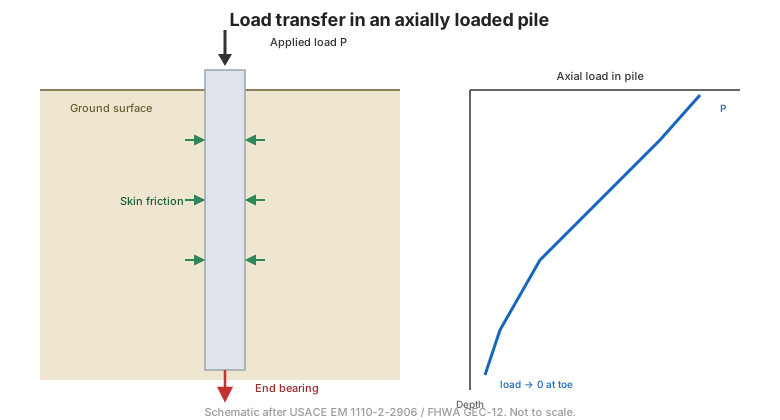
Figure. Load transfer in a pile: end bearing plus skin friction.
6.6 Negative skin friction and lateral squeeze
6.6.1 The negative-skin-friction phenomenon
When the soil around a pile settles more than the pile, the drag reverses: the soil now loads the pile downwards instead of supporting it. This negative skin friction (ma sát âm) adds load and must be added to the applied load, not subtracted from capacity.
6.6.2 Methods of calculating negative skin friction
6.6.3 Lateral squeeze of soft soil onto the pile shaft
6.7 Laterally loaded piles
6.7.1 Granular soil
6.7.2 Cohesive soil
6.7.3 Lateral reaction modulus from the Menard pressuremeter
6.8 Pile groups
6.8.1 The group effect
6.8.2 Terzaghi & Peck method with the fictitious block
6.8.3 Group efficiency factor \(C_e\)
6.8.4 Distribution of load within the group
6.9 Settlement of pile foundations
6.9.1 Single-pile settlement
6.9.2 Group settlement
6.10 Terminology
| English | Vietnamese (book) |
|---|---|
| deep foundation | móng sâu |
| pile | cọc / móng cọc |
| end bearing | sức kháng mũi cọc |
| skin friction | ma sát thành (hông) cọc |
| driven pile | cọc đóng |
| bored pile | cọc khoan nhồi |
| pressed pile | cọc ép |
| negative skin friction | ma sát âm |
| lateral squeeze | lực xệ ngang |
| pile group / group effect | nhóm cọc / hiệu ứng nhóm |
| group efficiency | hệ số hiệu dụng nhóm cọc |
| lateral reaction modulus | mô đun phản lực ngang |
6.11 Key takeaways
- Pile capacity is the sum of end bearing and skin friction: \(Q_L = Q_p + Q_f\).
- Driven piles mobilise friction better than bored piles in the same soil.
- Negative skin friction adds load — never subtract it from capacity.
- Lateral capacity needs a lateral reaction modulus, obtainable from the Menard pressuremeter.
- Piles work as a group; account for the group effect and group settlement.