Chapter 11 — Retaining Walls & MSE Walls
11.1 Wall types
- Gravity walls — mass concrete or stone; resist pressure by their own weight.
- Cantilever walls — a reinforced-concrete stem on a base; the most common type.
- Counterfort and buttress walls — cantilever walls with ribs for tall heights.
- Mechanically stabilized earth (MSE) walls — a facing panel plus soil reinforcement (strips, grids, or geotextiles) in the backfill.
- Sheet pile and bored-pile walls — covered in Chapter 12.
11.2 Stability checks
Every retaining wall is checked for three failure modes:
- Overturning about the toe — the resisting moment (weight, passive pressure) must exceed the overturning moment from the lateral thrust.
- Sliding along the base — the resisting force (base friction plus passive pressure) must exceed the driving lateral force.
- Bearing failure of the foundation soil — the eccentric base pressure must not exceed the allowable bearing pressure, and should keep the resultant within the middle third where possible.
A global slope stability check (Chapter 13) is also required, since the wall and its retained soil can fail as a mass.
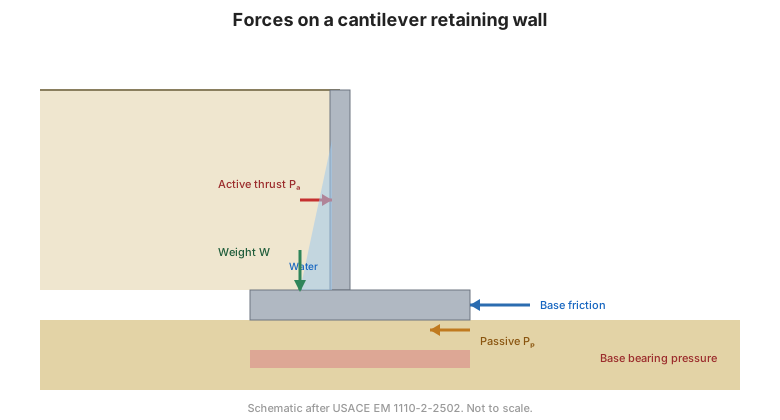
Figure. Forces on a cantilever retaining wall: lateral earth thrust and water pressure push the wall, resisted by its weight, base friction, and passive pressure at the toe (after USACE EM 1110-2-2502).
11.3 Drainage and backfill
Drainage is the single most important detail. A wall must never be designed to resist full hydrostatic pressure unless it truly cannot drain:
- provide a weep hole system and/or a drainage blanket behind the wall;
- use free-draining granular backfill;
- filter the drainage to prevent clogging.
Backfill is placed and compacted in lifts, with compaction controlled to avoid locking in excessive lateral pressure (Chapter 10).
11.4 Mechanically stabilized earth (MSE) walls
MSE walls carry the lateral thrust into soil reinforcement that extends into the retained fill. Key design aspects:
- Internal stability — the reinforcement must not break or pull out; tension is highest at the facing and decreases with depth.
- External stability — the reinforced soil mass as a whole must not slide, overturn, or overstress the foundation.
- Facing — panels, blocks, or wrapped geotextile.
- Corrosion and durability — metallic reinforcement must be protected against corrosion; design life governs the thickness.
MSE walls are economical, tolerate settlement, and are extensively covered in the FHWA GEC-11 manual.
11.5 Key takeaways
- Check every wall for overturning, sliding, and bearing — plus global stability.
- Drainage is the most important design detail — never trap water behind a wall.
- MSE walls transfer thrust into soil reinforcement; check internal and external stability and durability.
- Keep the base resultant within the middle third where possible.