Chapter 1 — Introduction: An Overview
1.1 What geotechnical instrumentation is
Geotechnical instrumentation is the measurement of parameters that reveal how soil, rock, foundations, and structures behave under load. It converts the invisible — internal pore pressure, deep deformation, hidden stress — into numbers that engineers can act on.
Typical measured parameters include:
- Groundwater (pore) pressure
- Total and effective stress
- Deformation (settlement, heave, lateral movement)
- Load and strain in structural members
- Temperature (which affects nearly every other reading)
1.2 Why it is needed
We cannot see underground. A slope may be sliding on a deep shear plane, a foundation may be settling differentially, a tunnel may be converging — none visible from the surface. Instrumentation makes the hidden observable and, crucially, measurable over time, so trends are caught early.
1.3 The chain of success
Dunnicliff frames monitoring as a chain with 25 links, from the moment a project's need is defined to the moment a reading informs a decision. Break any link — poor planning, wrong instrument, bad installation, unread data — and the whole effort fails. This book is, in effect, a tour of those links.
1.4 Behavior of soil and rock (brief)
Instrument selection depends on how soil and rock actually respond to load:
- Soil deforms, consolidates, and can lose strength when pore pressure rises.
- Rock behaves via joints and discontinuities more than via intact strength.
- Interfaces (soil–structure, rock–support) are where movement often concentrates.
Understanding these fundamentals is prerequisite to choosing what to measure.
1.5 Scope of this reference
This book covers the planning, instruments, execution, and interpretation of geotechnical monitoring for slopes, embankments, dams, tunnels, foundations, and excavations. It is original, educational content adapted from Dunnicliff's scope; it is not a reproduction of the copyrighted text.
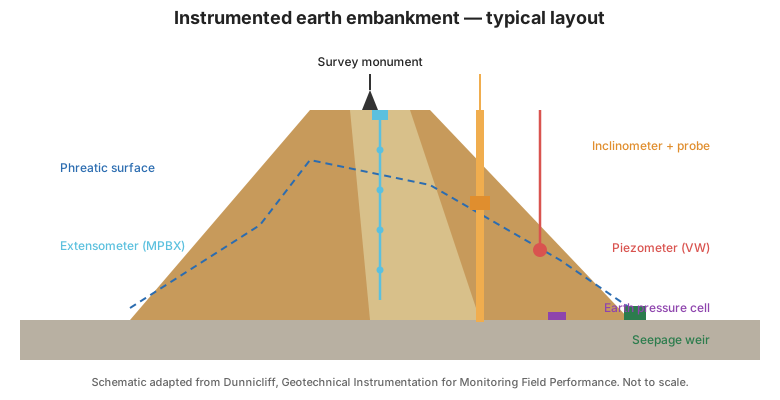
Figure. A typical instrumented earth embankment: survey monument, extensometer (MPBX), inclinometer with probe, piezometer, earth pressure cell, and seepage weir, with the phreatic surface (Dunnicliff, Ch. 1 and 8).
1.6 Key takeaways
- Instrumentation makes the hidden subsurface observable and measurable.
- It is a chain of 25 links; failure at any link defeats the purpose.
- Soil and rock behave differently; selection follows behavior.
- Judgment, not hardware alone, produces useful monitoring.