Chapter 5 — Shallow Foundation Analysis
Chapter V is the first of the analysis chapters. It defines a shallow foundation, then covers bearing capacity from several independent methods and settlement from several independent methods — the two checks every shallow foundation must pass.
5.1 Basic concepts
5.1.1 Definition of a shallow foundation
The handbook uses the geometry of the foundation itself:
- Footing width \(B\), footing length \(L\), embedment depth \(D\) (measured from the base to ground surface).
- A foundation is shallow when \(\dfrac{D}{B} < 4\).
- A strip footing (móng băng) has \(\dfrac{L}{B} > 5\).
- An isolated footing (móng đơn) has \(\dfrac{L}{B} < 5\).
- Special shapes: circular \(B = 2R\); square \(B = L\); rectangular \(B < L < 5B\).
- A mat / raft (móng bè) is a large foundation carrying a whole structure or part of it.
The handbook notes these limits are relative, not absolute.
5.1.2 Behaviour of a shallow foundation under load
Foundation displacement depends on the level of loading. The load–settlement curve (đường quan hệ tải trọng – chuyển vị) identifies:
- the ultimate load \(Q_L\) — the maximum load the foundation can carry before the soil fails;
- the allowable load — the load giving acceptable settlement and an adequate factor of safety against \(Q_L\).
5.1.3 Failure of the foundation soil
The failure mechanism beneath a shallow foundation — general shear, local shear, punching — and how the failure surface develops.
5.1.4 Ultimate load on a horizontal strip footing in uniform ground
The general ultimate-load formula for a centred vertical load on a horizontal strip footing in homogeneous soil, from which the classical bearing-capacity equations are derived.
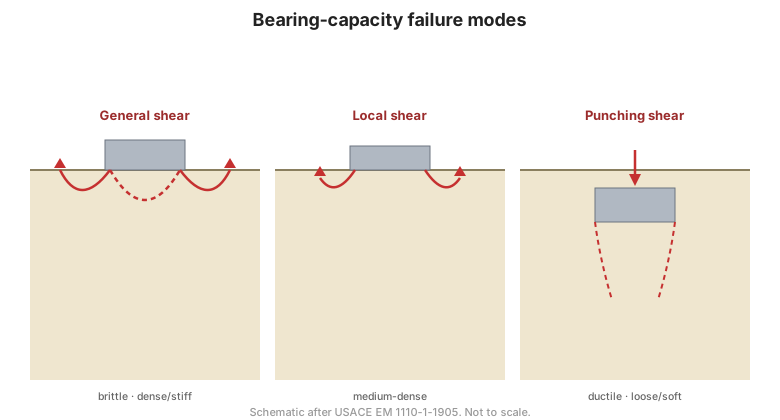
Figure. Bearing-capacity failure mechanisms beneath a shallow foundation.
5.2 Bearing capacity of shallow foundations
The handbook deliberately gives several independent routes to the same answer, so that results can be cross-checked:
5.2.1 From soil-mechanics theory
The classical theoretical bearing-capacity solution.
5.2.2 From the cone penetration test (CPT)
Empirical correlations between cone resistance \(q_c\) and bearing capacity.
5.2.3 From the Menard pressuremeter (PMT)
Using the limit pressure \(P_l\) and pressuremeter modulus \(E_p\).
5.2.4 From the SPT
Using the blow count \(N\) — the most common route in Vietnamese practice.
5.2.5 On rock
Bearing capacity of a footing founded on rock.
5.3 Settlement of shallow foundations
5.3.1 Stress distribution beneath the foundation — Boussinesq
The elastic (Boussinesq) stress distribution used to find the increase in vertical stress with depth.
5.3.2 Consolidation settlement by the layer-summation method
Dividing the compressible stratum into sub-layers and summing their contributions.
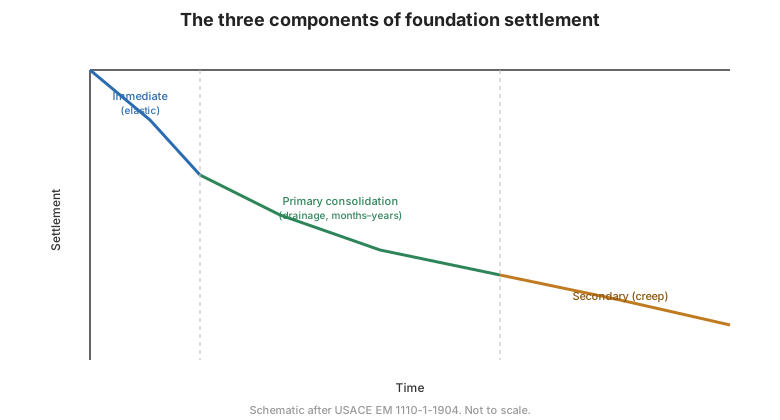
Figure. Settlement components beneath a footing.
5.3.3 Elastic settlement by the general method
5.3.4 Settlement from the Menard pressuremeter
5.3.5 A rapid method for estimating settlement
5.3.6 Allowable settlement
5.4 Terminology
| English | Vietnamese (book) |
|---|---|
| shallow foundation | móng nông |
| strip footing | móng băng |
| isolated / pad footing | móng đơn |
| mat / raft | móng bè |
| embedment depth | chiều sâu chôn móng |
| ultimate load | tải trọng giới hạn |
| allowable bearing pressure | áp lực cho phép |
| bearing capacity | sức chịu tải |
| load–settlement curve | đường quan hệ tải trọng – chuyển vị |
| settlement | độ lún |
| layer-summation method | phương pháp phân tầng |
| allowable settlement | độ lún cho phép |
5.5 Key takeaways
- Shallow vs deep is defined by \(D/B < 4\); strip vs isolated by \(L/B\).
- Design has two independent checks: bearing capacity and settlement.
- The handbook gives multiple methods for each so results can be cross-checked — theory, CPT, PMT, SPT, rock.
- SPT is the most widely used route in Vietnamese practice.
- Settlement prediction rests on Boussinesq stress distribution plus layer-summation (or the pressuremeter method).