Chapter 13 — Performance Evaluation and Decision Making
13.1 Monitoring exists to support decisions
The purpose of all the preceding work is a defensible answer to one question: given what the monitoring shows, what should we do? This chapter connects measurement to action.
13.2 A structured response to anomalies
When a threshold is exceeded or an evaluation finds a real departure:
- Verify — confirm it is not a sensor or data fault.
- Assess — compare with the failure mode it guards; rate the severity.
- Intensify — increase reading frequency and dispatch inspection (Chapter 3).
- Decide — continue normal, investigate, restrict reservoir operation, or act to remediate.
- Document — record the decision and its rationale.
13.3 Action levels
Many programs define tiered action levels tied to thresholds:
| Level | Meaning | Response |
|---|---|---|
| Normal | Within baseline | Routine monitoring |
| Alert | Exceeds baseline band | Review, verify, watch |
| Alarm | Exceeds danger threshold | Intensify, restrict operation, notify |
These levels turn raw numbers into a shared, pre-agreed response — faster and less emotional during an emergency.
13.4 Reservoir operation as a lever
Often the most immediate action is operational: lower the reservoir to reduce loads and seepage while the cause is found. Monitoring data justifies and guides that decision in real time.
13.5 Risk-informed judgment
Decisions weigh the consequence of failure against the credibility of the observed trend. A small, well-explained change on a low-consequence feature may need only monitoring; the same change on a high-consequence failure mode demands urgent action. There is no universal rule — judgment, informed by the monitoring, is required.
13.6 Closing the loop
A good program learns. Each anomaly, whether benign or serious, updates the baseline, the thresholds, and the plan. Over the dam's life, the monitoring program itself improves.
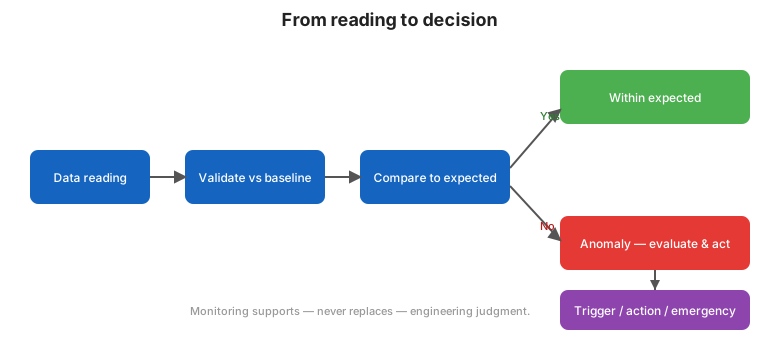
Figure. From reading to decision: validate against the baseline, compare to expected behavior, then act (ASCE MOP-135 scope).
13.7 Key takeaways
- Monitoring's purpose is a defensible decision: what should we do?
- Respond with verify → assess → intensify → decide → document.
- Pre-agreed action levels make emergencies faster and calmer.
- Reservoir operation is often the first lever; judgment weighs consequence vs. credibility.