Chapter 13 — Slope Stability
13.1 Why slopes fail
A slope fails when the shear stress along a potential slip surface exceeds the shear strength of the soil. The factor of safety is the ratio of available strength to mobilized stress:
Failure can be sudden (brittle, in dense soils or rock) or progressive (soft clays, weathered rock), and may be triggered by rainfall, excavation, loading, or seismic action.
13.2 Infinite slopes
For a long, uniform slope where the slip surface is parallel to the surface, the factor of safety has a closed-form solution. Two cases matter:
- Dry or drained slope — governed by the friction angle and slope angle.
- With seepage — pore pressures reduce effective stress and the factor of safety, often dramatically. This is why drainage is the primary stabilisation measure.
13.3 Finite slopes and the method of slices
Real slopes are analysed with limit-equilibrium methods that divide the potential slip mass into vertical slices:
- Ordinary method of slices (Fellenius) — simple, conservative.
- Bishop's simplified method — accounts for interslice forces and is the workhorse of practice.
- Spencer and Morgenstern–Price — rigorous, satisfying all equilibrium conditions.
The analysis searches for the critical slip surface — the one giving the lowest factor of safety. Computer methods (e.g. STABL, SLOPE/W) automate the search.
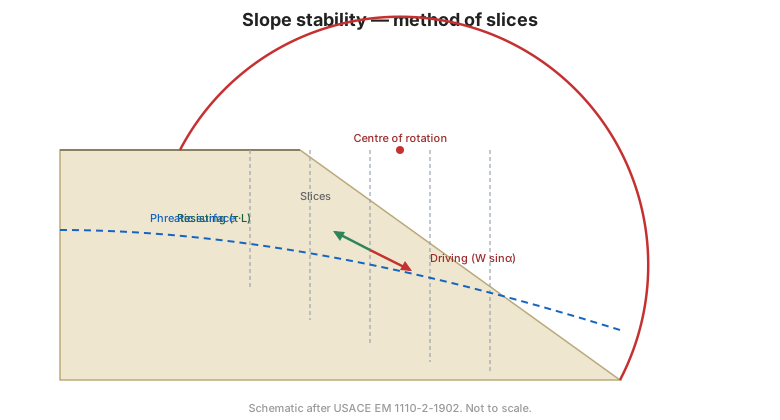
Figure. Slope stability by the method of slices: the driving and resisting forces on each slice, and the search for the critical slip surface (after USACE EM 1110-2-1902).
13.4 Short-term and long-term conditions
- Short-term (undrained) — immediately after construction or excavation, using undrained shear strength \(c_u\); critical for soft clays.
- Long-term (drained) — after pore pressures equilibrate, using effective stress parameters \(c', \phi'\); often critical in stiff clays and on slopes with seepage.
Both must be checked, and the lower factor of safety governs.
13.5 Stabilization methods
When a slope is unstable, options include:
- Drainage — surface and subsurface; the most effective and economical.
- Regrading — flattening the slope or adding a toe berm.
- Retaining structures — walls, sheet piles, or reinforced soil at the toe.
- Ground improvement — soil nails, anchors, or reinforcement (Chapter 14).
- Reinforcement — soil nails, tie-backs, or geosynthetics.
13.6 Key takeaways
- Slopes fail when shear stress exceeds shear strength; the factor of safety is the ratio.
- Seepage reduces the factor of safety — drainage is the primary fix.
- Use the method of slices (Bishop for practice) and search for the critical slip surface.
- Check short-term and long-term conditions; the lower \(F\) governs.
- Stabilize by drainage, regrading, retaining structures, or reinforcement.