Chapter 7 — Seepage, Leakage, and Phreatic-Surface Monitoring
7.1 Seepage is both normal and dangerous
Some seepage through and under a dam is expected and acceptable. The danger is change — increasing flow, turbidity, or seepage through new paths. Seepage monitoring answers two questions: how much and how clean.
7.2 Measuring quantity
| Method | How | Notes |
|---|---|---|
| Weir / flume | Measure depth over a notch, compute flow | Simple, reliable total-flow measurement |
| Tipping bucket | Count tips of a known volume | Good for automated, low-flow logging |
| Container + stopwatch | Time to fill a known volume | Crude but useful for spot checks |
| Observation + mapping | Location, area, wetness | Essential; many leaks are diffuse |
7.3 Measuring quality — turbidity
The clarity of seepage is often more important than its volume. Clear seepage through a known path is usually benign; turbid or sandy seepage can signal internal erosion. Simple observations (visual, "jar test") and, increasingly, turbidity sensors or filter-catch devices provide early warning.
Muddy seepage is a red flag
Sudden turbidity, especially after a reservoir rise or quake, can indicate internal erosion. It warrants immediate field verification and, often, intensified monitoring.
7.4 The phreatic surface
The phreatic surface (seepage line) inside an embankment is the boundary between saturated and unsaturated zones. It is inferred from piezometer readings (Chapter 6). A phreatic line that rises above the design assumption reduces downstream slope stability and may indicate clogged drains.
7.5 Leakage at appurtenances
Conduits, outlet works, and abutment contacts are common seepage paths. Monitor for wetness, staining, and flow near:
- Conduit inlet and outlet structures.
- Grout curtains and cutoff walls (look for increased downstream seepage).
- Abutment contacts between embankment and foundation or walls.
7.7 Establishing a baseline and trend
Track seepage against reservoir level. Plot seepage vs. reservoir elevation for each measurement point. A point that departs upward from its historical band — especially with turbidity — is an anomaly demanding evaluation (Chapter 12).
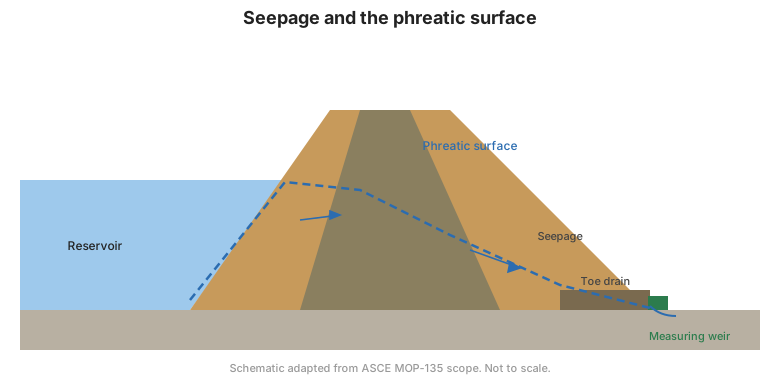
Figure. Seepage and the phreatic surface through an embankment dam, with a toe drain and measuring weir (ASCE MOP-135 scope).
7.8 Key takeaways
- Monitor seepage quantity and quality; turbidity often matters more than volume.
- Weirs and tipping buckets quantify flow; observation maps diffuse leaks.
- Track the phreatic surface from piezometers; a rising line reduces slope stability.
- Watch appurtenances; muddy or increasing seepage is a red flag.