Chapter 6 — Measurement of Groundwater Pressure
6.1 Pore pressure is everywhere important
Groundwater (pore) pressure governs effective stress, slope stability, settlement, and liquefaction. Measuring it is one of the most common and most consequential monitoring tasks.
6.2 Piezometer types
| Type | Principle | Best for |
|---|---|---|
| Vibrating-wire (VW) | Frequency change of a tensioned wire | Long-term automated monitoring; robust |
| Pneumatic | Gas pressure balances water pressure | Remote, no power |
| Standpipe (open) | Water level in a pipe | Simple, direct, slow to equilibrate |
| Hydraulic (twin-tube) | Liquid-column balance | Multiple points, established method |
6.3 The saturation imperative
A VW or pneumatic piezometer must be fully saturated — free of air in the porous filter and connecting tube — or it reads nonsense. The saturation procedure (de-airing, filling, and checking) is the single most neglected step in field installation. An unsaturated piezometer is a silent gap in the program.
6.4 Installation in soil, rock, and boreholes
- Soil: careful borehole drilling to avoid smearing the surrounding soil; filter pack and sealing to prevent short-circuiting.
- Rock: packer or grouted installations to isolate the measurement zone.
- Multi-level (MPBX): several sensors in one borehole to profile pressure with depth.
6.5 Reading and interpretation
Readings convert to piezometric head. Interpret against:
- Phreatic surface location and change.
- Pore-pressure response to rainfall, pond level, or loading.
- Excess pressure after seismic or construction events.
6.6 Pitfalls
- Air ingress / loss of saturation → drifting readings.
- Borehole short-circuiting → reads the wrong zone.
- Cabling damage → the most common automated failure.
Cross-check with a standpipe
Where pore pressure is critical, a simple open standpipe alongside VW sensors provides an independent, foolproof check that the automated data is physically sensible.
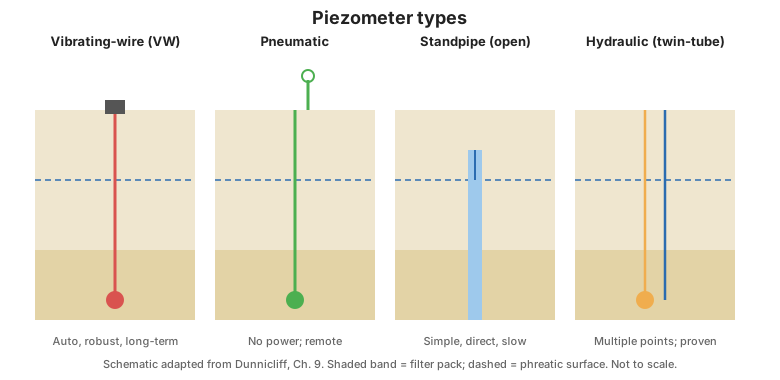
Figure. Four common piezometer types: vibrating-wire, pneumatic, open standpipe, and twin-tube hydraulic (Dunnicliff, Ch. 9).
6.7 Key takeaways
- Pore pressure governs effective stress and stability.
- Saturate every piezometer; verify it.
- Isolate the measurement zone; prevent short-circuiting.
- Standpipes offer a cheap independent cross-check.