Chapter 7 — Measurement of Stress
7.1 Two different stress problems
Stress monitoring splits into two distinct tasks:
- Total stress in soil — the pressure exerted by soil or a structure on a plane (e.g., against a retaining wall, under a footing).
- Stress change in rock — the change in the in-situ stress field caused by excavation or loading.
The instruments and methods differ sharply.
7.2 Total stress in soil — earth pressure cells
Earth pressure cells measure the total normal stress acting on a plane:
- Hydraulic cells — liquid-filled, robust, good for total pressure.
- Vibrating-wire cells — automated, common in walls and embankments.
- Pneumatic cells — no power needed.
- Contact stress cells — measure pressure at a soil–structure interface.
Installation must place the cell's sensing face flush with the surface it monitors, with minimal disturbance, or the reading is biased.
7.3 Stress change in rock
Rock stress changes are measured by instruments placed in boreholes:
- Borehole pressure cells / stressmeters — monitor stress change around openings.
- Flat jacks — measure stress relief in a slot.
- Overcoring — a stress-relief method that, with strain measurement, back-calculates the original in-situ stress state.
7.4 Interpretation cautions
Stress measurements are sensitive to installation disturbance and to the stiffness mismatch between cell and ground. Read them as relative change more reliably than as absolute values, and correlate with deformation (Chapter 8).
Stiffness mismatch
A cell much stiffer than the surrounding soil over-reads; much softer, under-reads. Match the cell to the medium, or interpret with that bias in mind.
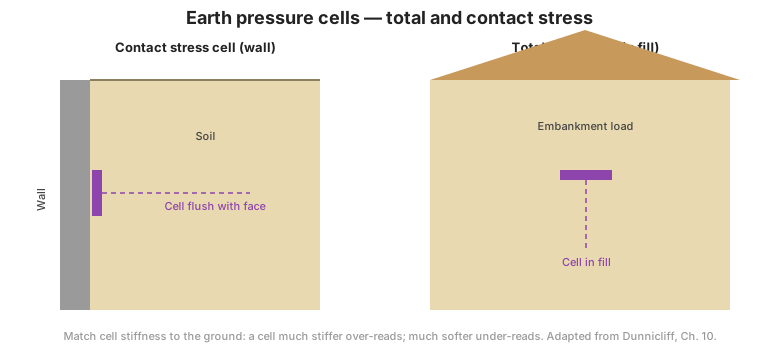
Figure. Earth pressure cells. A contact-stress cell measures pressure against a structure; a total-stress cell is buried in fill. Match cell stiffness to the ground (Dunnicliff, Ch. 10).
7.5 Key takeaways
- Total stress in soil and stress change in rock need different instruments.
- Earth pressure cells need flush, undisturbed installation.
- Rock stress is best read as change, via cells, flat jacks, or overcoring.
- Account for stiffness mismatch when interpreting.