Chapter 1 — Introduction and the Key to Success
1.1 Scope of this module
There are two general categories of measuring instrument in geotechnical work:
- Subsurface investigation instruments — used during the design phase to determine soil and rock properties such as strength, compressibility, and permeability (for example, in-situ tests and borings).
- Performance-monitoring instruments — used during the construction and operation phases to monitor how the ground and the structure actually behave, typically measuring groundwater pressure, total stress, deformation, load, or strain.
This reference is concerned only with the second category. It covers the hardware for measuring groundwater pressure, deformation, total stress in soil, and load and strain in structural members; a systematic approach to planning monitoring programs; instrument selection for each type of construction; and the general field tasks of calibration, maintenance, installation, data collection, processing, presentation, interpretation, and reporting.
1.2 The general role of geotechnical instrumentation
Every geotechnical design is, to some degree, hypothetical. Natural materials were created by processes that seldom produce uniform conditions, and exploratory procedures cannot detect in advance every significant property or condition. The designer must therefore make assumptions that may differ from reality, and the constructor must choose equipment and procedures without full knowledge of what will be encountered.
Field observations — including quantitative measurements from instrumentation — are the means by which the engineer can, despite these limitations, design a project that is safe and efficient, and by which the constructor can execute the work with safety and economy. This is why geotechnical engineering differs from most other branches of engineering, where practitioners have far greater control over the materials they use. For the geotechnical engineer, instrumentation is not an optional extra — it is a working tool.
The practice of geotechnical instrumentation is a marriage between the capabilities of measuring instruments and the capabilities of people. Pulling an instrument from a shelf, installing it, and taking readings may look simple, but obtaining useful information requires considerable engineering and planning.
1.3 The key to success — a chain of links
Full benefit is achieved only if every step in the planning and execution process is carried out with great care. The useful analogy is a chain with many potential weak links: a monitoring program breaks down more easily and more often than most other geotechnical endeavors, and the failure can usually be traced to a weakness in one or more links.
The program has:
- 21 planning links (Phase I), defined in Chapter 6, from define the project conditions through write specifications for field instrumentation services.
- 10 execution links (Phase II), discussed in Chapter 13, from procure instruments through implement.
The strength of these 31 links depends on both the instruments and the people. Success is maximized by maximizing the strength of every link.
1.4 The golden rule
Every instrument on a project should be selected and placed to assist with answering a specific question: if there is no question, there should be no instrumentation.
This rule, restated throughout the manual, is the single most important filter in instrumentation planning. Instruments installed without a question become clutter, consume budget, and — worse — can be ignored, discrediting the value of monitoring altogether.
1.5 Course objectives
On completing the material in this reference, the reader should be able to:
- Select monitoring equipment knowledgeably from the range of available instrumentation.
- Plan instrumentation programs in a systematic way.
- Understand the general role of instrumentation, the principal geotechnical
questions, and the applicable instruments for:
- soil slopes and embankments,
- deep foundations,
- earth retaining structures,
- ground improvement techniques,
- rock slopes.
- Understand practical methods for calibration and maintenance, installation, data collection, processing and presentation, interpretation, and reporting.
- Apply the golden rule to every instrument on a project.
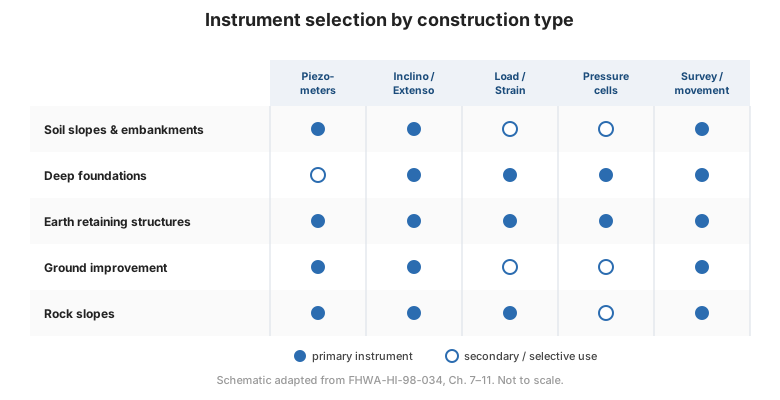
Figure. Which instrument families answer the questions raised by each type of construction — the map for Chapters 7–11 (after FHWA-HI-98-034, Ch. 7–11).
1.6 Key takeaways
- Instrumentation for performance monitoring is a distinct discipline from subsurface investigation.
- Geotechnical design is hypothetical; instrumentation is how we test it in the field.
- A monitoring program is a chain of 31 links (21 planning + 10 execution) — one weak link can break it.
- No question, no instrument. The golden rule governs every decision.