Chapter 5 — Load, Strain & Temperature
5.1 Introduction
This chapter covers instruments that measure the load carried by a structural member, the strain (and hence stress) in it, and the temperature that affects both. These measurements are central to load tests on deep foundations (Chapter 8) and to monitoring struts, anchors, and ties in earth retaining structures (Chapter 9).
5.2 Load cells
A load cell measures the force in a member it is inserted into or placed under:
- Hydraulic load cells — a fluid-filled pad; applied load raises the fluid pressure, which is read on a gage or transducer. Robust and simple.
- Electrical resistance load cells — strain gages bonded to a member convert load to an electrical signal.
- Calibrated hydraulic jacks with a center hole — used to apply and measure load in tensioning operations (for example, anchors and rock bolts). A caution: the load determined from fluid pressure in a jack can carry a systematic error from friction, so jacks must be calibrated.
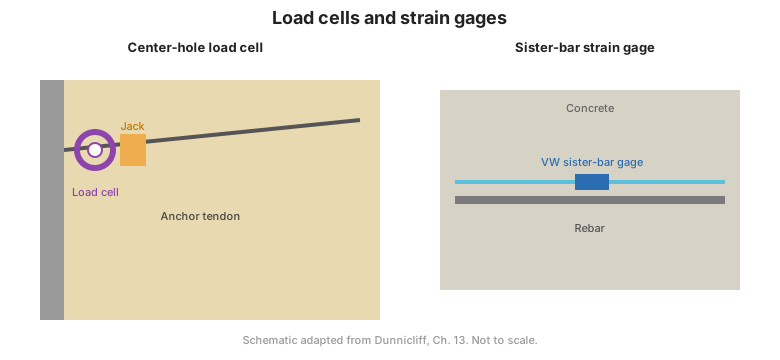
Figure. Load cells and strain gages: hydraulic and electrical load cells measure member force, while bonded and vibrating-wire gages measure strain (after FHWA-HI-98-034, Ch. 5).
5.3 Surface-mounted strain gages
- Mechanical strain gages — e.g., the Demec gage, which measures the change in distance between two reference discs on a surface.
- Surface-mounted vibrating-wire strain gages — welded or bonded to a steel member; robust and suited to long-term monitoring.
- Surface-mounted electrical resistance strain gages — bonded foil gages for short-term, high-resolution measurements.
Relationship between strain and stress: converting measured strain to stress requires the member's elastic modulus (\(\sigma = E\varepsilon\)). This conversion is a common source of error and must be handled explicitly.
5.4 Embedment strain gages
- Vibrating-wire embedment strain gages — cast into concrete to measure internal strain over the long term.
- Electrical resistance embedment gages — for shorter-term measurements.
- Relationship between strain and stress — as above, but for concrete the modulus, creep, and thermal effects all require care.
5.5 Sister bars
A sister bar is a short length of reinforcing bar instrumented with vibrating-wire gages, tied alongside the main reinforcement. It measures the strain in the rebar at that location, which is used to estimate the load the concrete section carries — a standard technique for load tests and for monitoring instrumented sections.
5.6 Multiple telltales for stress determination
Multiple telltales — anchors at several depths referenced to a stable head — resolve the relative movement between points, from which the strain in each interval (and hence the load distribution) can be determined.
5.7 Temperature measurement
Temperature affects vibrating-wire and strain instruments, and thermal movement can dominate measured deformation. Temperature is measured with:
- Thermistors and resistance temperature detectors (RTDs) — accurate, easily logged.
- Thermocouples — wide range, lower absolute accuracy.
- Vibrating-wire temperature sensors — convenient when sharing the same logger as the strain instruments.
Instruments and dataloggers should record temperature alongside strain so that thermal corrections can be applied.
5.8 Key takeaways
- Load cells measure member force; strain gages measure strain, which converts to stress via the elastic modulus.
- Calibrate hydraulic jacks — fluid-pressure readings carry friction error.
- Sister bars and multiple telltales are the practical way to instrument reinforcement and resolve load distribution.
- Always record temperature with load/strain data so corrections can be made.