Chapter 10 — Engineering Hydraulics
Chapter X covers the hydraulics of soil: how water moves through the ground and what that does to stability. It covers the states of water in soil, Darcy's law, permeability, two-dimensional flow, flow nets, seepage forces, and their application to cut-off walls, excavations and earth dams.
10.1 Free-water movement
10.1.1 States of water in the ground
The handbook distinguishes three states:
- Formation water (nước thành tạo) — water held in the chemical structure of the mineral particles.
- Bound water (nước liên kết) — water adsorbed as a film on the particle surfaces.
- Pore water (nước lỗ rỗng) — water in the voids, of which there are two kinds: capillary water (nước mao dẫn) and free water (nước tự do).
Free water below the water table obeys the laws of fluid flow; capillary water is held by surface tension and is in equilibrium between the weight of the water column and the upward suction.
10.1.2 Straight-line flow — Darcy's law
For laminar flow through soil, the discharge velocity is proportional to the hydraulic gradient:
where \(k\) is the coefficient of permeability and \(i\) is the hydraulic gradient.
10.1.3 Coefficient of permeability and its determination
Laboratory (constant-head, falling-head) and field (pumping test) methods.
10.2 Two-dimensional flow in a homogeneous isotropic medium
10.2.1 The flow net
A flow net (mạng dòng chảy) is a graphical solution of Laplace's equation: a family of flow lines crossing a family of equipotential lines at right angles.
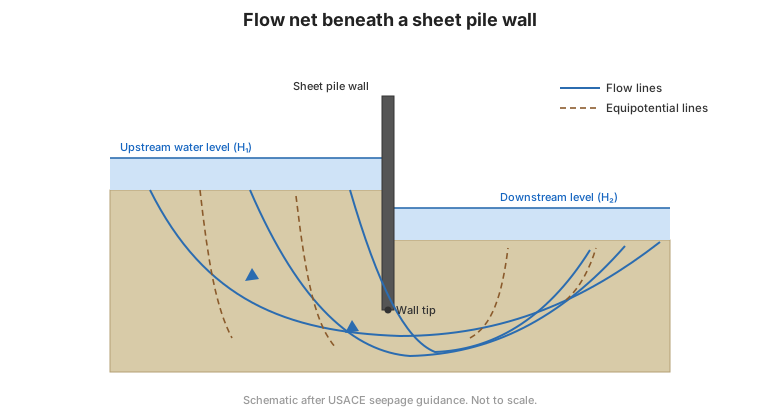
Figure. Flow net for seepage beneath a sheet-pile wall.
10.2.2 Seepage discharge through a soil mass
10.2.3 Seepage force (lực đẩy của dòng chảy)
Water flowing through soil exerts a seepage force on the soil skeleton in the direction of flow. Where flow is upward, the force reduces effective stress and can lead to piping or boiling.
10.2.4 A vertical cut-off wall in a permeable stratum
10.2.5 A cut-off wall for an excavation
10.2.6 For dykes and earth dams
10.3 Terminology
| English | Vietnamese (book) |
|---|---|
| formation water | nước thành tạo |
| bound water | nước liên kết |
| pore water | nước lỗ rỗng |
| capillary water | nước mao dẫn |
| free water | nước tự do |
| Darcy's law | định luật Darcy |
| hydraulic gradient | gradient thuỷ lực |
| coefficient of permeability | hệ số thấm |
| flow net | mạng dòng chảy |
| flow line / equipotential line | đường dòng / đường đẳng thế |
| seepage force | lực đẩy của dòng chảy |
| piping / boiling | xói ngầm / bùng nền |
10.4 Key takeaways
- Water in soil exists as formation, bound and pore water; pore water is capillary or free.
- Darcy's law \(v = ki\) governs laminar seepage.
- A flow net solves 2-D flow graphically.
- Seepage force acts on the soil skeleton; upward flow reduces effective stress and can cause piping.
- The same theory applies to cut-off walls, excavations and earth dams.