Chapter 10 — Shear Strength
10.1 The Mohr–Coulomb criterion
Shear strength is the soil's resistance to sliding — the property that governs bearing capacity, slope stability, and earth pressure. The Mohr–Coulomb criterion expresses it as:
\[\tau_f = c' + \sigma'_n \tan\phi'\]
where \(c'\) is effective cohesion, \(\sigma'_n\) is the effective normal stress, and \(\phi'\) is the effective friction angle. For total-stress (undrained) conditions, the same form uses \(c_u\) and \(\phi_u = 0\):
\[\tau_f = c_u\]
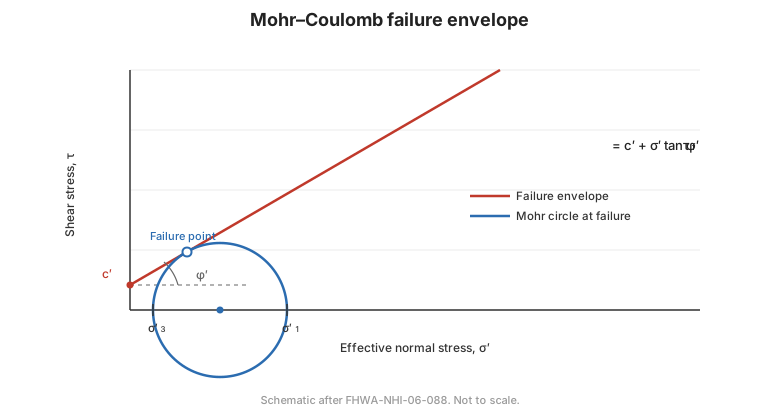
Figure. The Mohr–Coulomb failure envelope: shear strength \(\tau_f = c' + \sigma'\tan\phi'\), with the failure circle tangent to the envelope (after FHWA-NHI-06-088).
10.2 Drained vs. undrained strength
The choice of strength parameters depends on drainage:
- Drained — pore pressures have equilibrated; use effective parameters \(c', \phi'\). Critical for long-term conditions and for sands.
- Undrained — no drainage during loading; use total parameters, usually \(c_u\) with \(\phi = 0\). Critical for short-term conditions in saturated clays.
The lower factor of safety from both governs the design.
10.3 Laboratory tests
- Direct shear — simple, gives \(c'\) and \(\phi'\); drainage controllable.
- Triaxial compression — the most versatile: UU (unconsolidated undrained) for \(c_u\); CU (consolidated undrained) with pore-pressure measurement for effective parameters; CD (consolidated drained) for drained strength.
- Unconfined compression — a quick \(c_u\) for clays.
- Ring shear — for residual strength on pre-existing slip surfaces.
10.4 Factors affecting shear strength
- Density and stress history — denser and more over-consolidated soils are stronger.
- Cementation and structure — natural bonding adds apparent cohesion.
- Anisotropy and fissures — strength varies with direction; fissures weaken the mass.
- Rate of loading — undrained strength depends on loading rate.
- Residual strength — on a pre-existing slip surface, strength drops to the residual value, which governs reactivated landslides.
10.5 Key takeaways
- \(\tau_f = c' + \sigma'\tan\phi'\) (effective) or \(\tau_f = c_u\) (undrained).
- Choose drained vs. undrained by the drainage condition; the lower \(F\) governs.
- Triaxial tests give the full range: UU, CU, CD.
- Density, stress history, structure, and rate all affect strength.
- On slip surfaces, use residual strength.