Chapter 5 — Weathering and Soil
This is the chapter that matters most to a geotechnical engineer: weathering is the process that converts rock into soil. Every residual soil, every weathered profile, and every "soft" zone in a rock mass is the product of it.
5.1 Mechanical weathering
Rock is broken physically, without changing its minerals.
- Unloading / exfoliation — removal of overburden lets the rock expand; it cracks parallel to the new ground surface.
- Frost wedging — water in cracks freezes, expands by ~9 %, and prises the rock apart. Most effective where freezing and thawing alternate frequently.
- Salt crystallisation — salts grow in pores and push grains apart (honeycomb weathering).
- Roots and burrowing animals — roots widen every crack they enter.
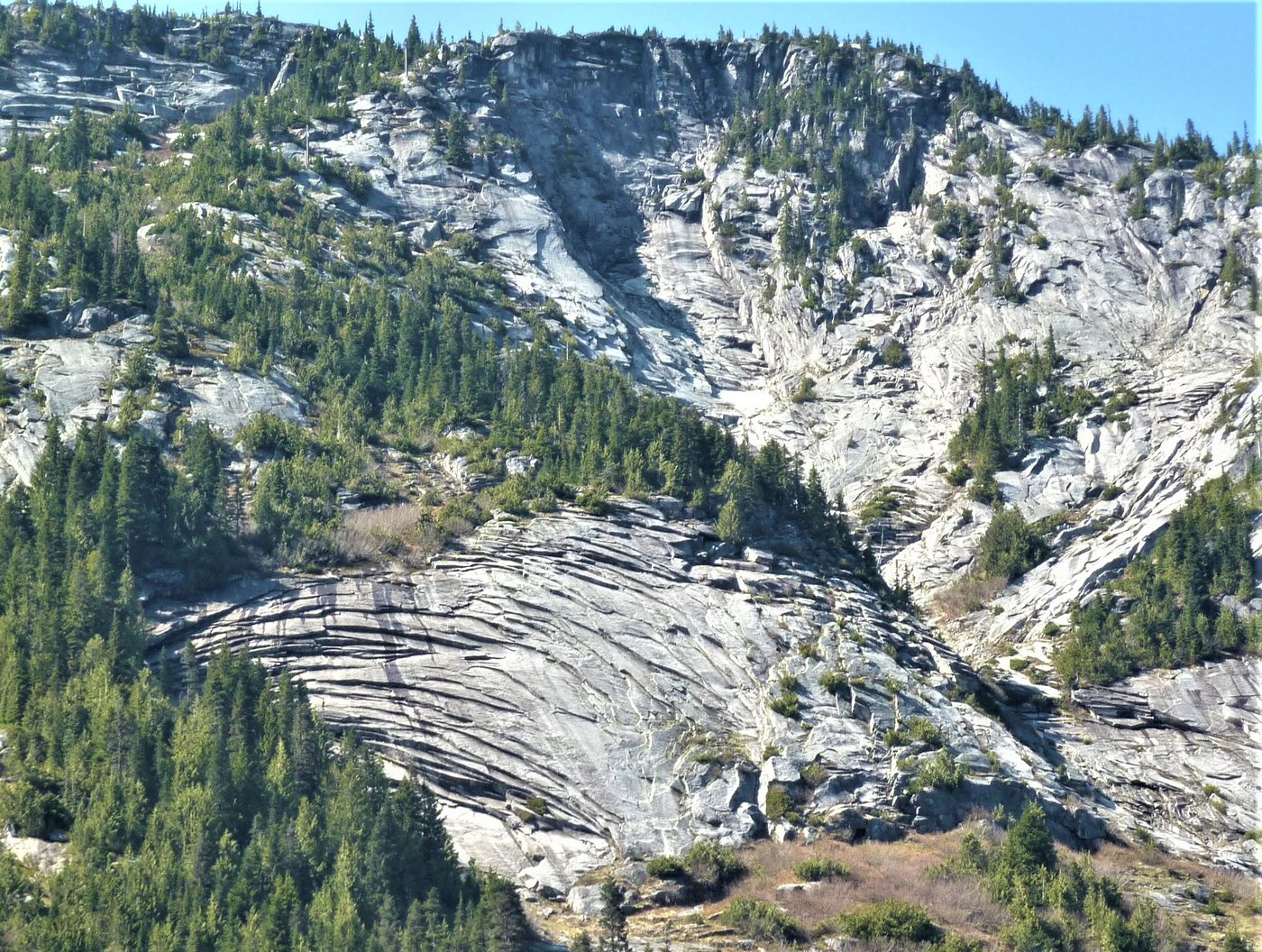
Figure. Exfoliation fractures in granite exposed by a road cut (Coquihalla Highway, B.C.). The rock peels in sheets parallel to the new surface because the confining pressure was removed. © Steven Earle, CC BY 4.0 — Physical Geology, 2nd ed., Fig. 5.1.1.
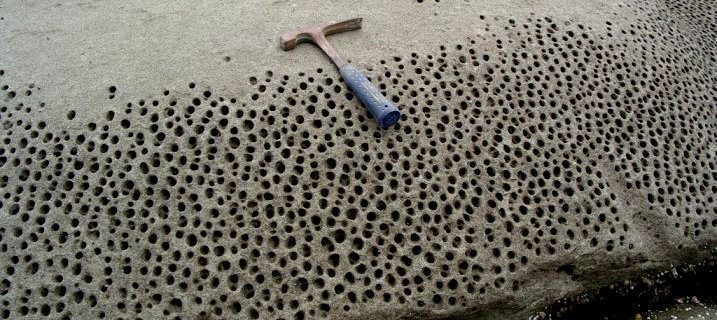
Figure. Honeycomb weathering of sandstone (Gabriola Island, B.C.), produced by salt crystallising in the pores. © Steven Earle, CC BY 4.0 — Physical Geology, 2nd ed., Fig. 5.1.5.
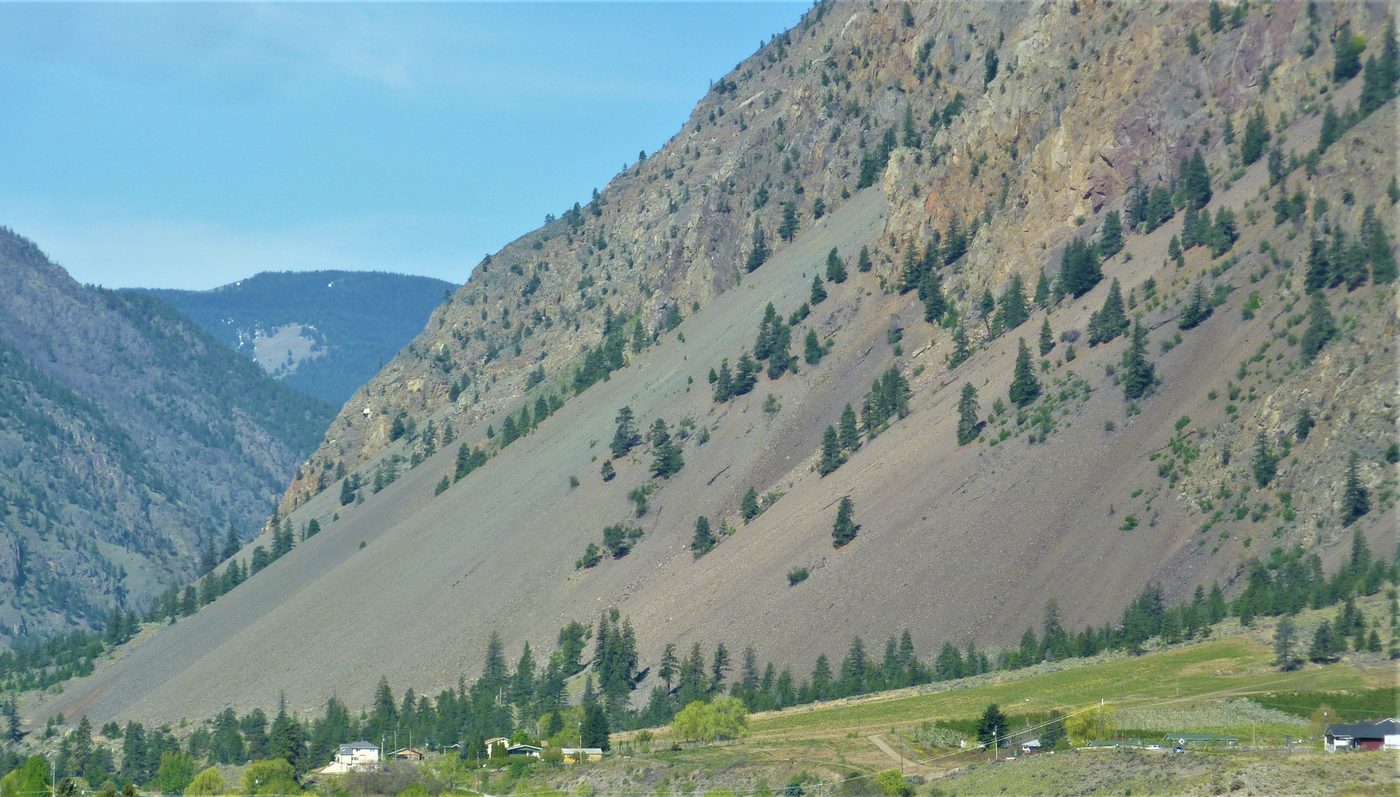
Figure. A talus deposit of frost-shattered debris at the foot of a cliff (Keremeos, B.C.) — colluvium, a loose and often metastable material. © Steven Earle, CC BY 4.0 — Physical Geology, 2nd ed., Fig. 5.1.4.
5.2 Chemical weathering
Rock is decomposed by reaction with water, oxygen and acids. The key reactions are hydrolysis (feldspar → clay minerals), oxidation (iron minerals → rust-coloured oxides) and dissolution (carbonates and evaporites). Chemical weathering is fastest in warm, wet climates — which is why deep weathering profiles are the norm in Vietnam.
5.3 Soil formation
Soil is a mixture of mineral grains, organic matter, air and water. The controls on how soil develops are climate, parent material, slope and time — the same four factors that determine whether a site has a thick residual soil or bare rock.
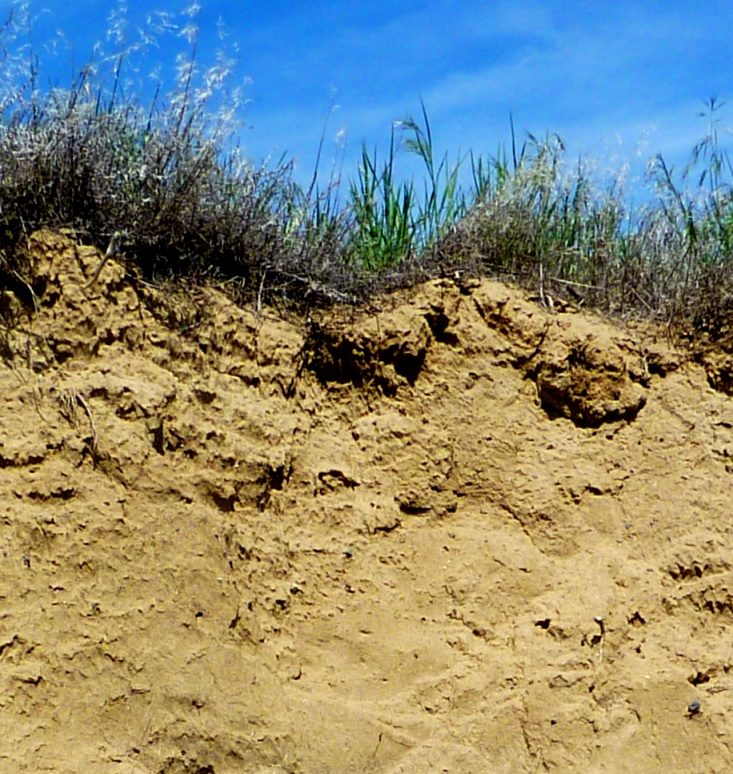
Figure. Poorly developed soil on wind-blown silt (loess) in an arid part of Washington State. The whole profile shown is about 1 m thick and the actual 'soil' is only the top 2-3 cm. © Steven Earle, CC BY 4.0 — Physical Geology, 2nd ed., Fig. 5.4.2.
5.4 Soil horizons
A mature soil profile develops distinct horizons — O (organic), A (mixed organic-mineral), E (leached), B (accumulation) and C (incompletely weathered parent material). For the engineer the significance is that each horizon has different strength, permeability and compressibility, and the water table commonly sits near a horizon boundary.
Key points for the geotechnical engineer
- Weathering defines the ground profile. The depth of weathering, not the rock type, is often what decides foundation depth.
- Mechanical and chemical weathering act together — frost opens the cracks that water then hydrolyses.
- Residual soil strength decreases upward as weathering increases; the transition to sound rock is gradational, not sharp.
- Karst is chemical weathering at landscape scale.
Terminology
| English | Vietnamese |
|---|---|
| weathering | phong hoá |
| mechanical / chemical weathering | phong hoá vật lý / hoá học |
| exfoliation (unloading) | bong tróc (giảm tải) |
| frost wedging | nêm băng |
| hydrolysis | thuỷ phân |
| residual soil | đất tàn dư |
| soil horizon | tầng phát sinh đất |
| colluvium / talus | taluy (tích tụ sườn) |
Digest of Chapter 5, Physical Geology – 2nd Edition, by Steven Earle (CC BY 4.0).