Chapter 7 — Slope Stability Analysis
Chapter VII concerns the stability of slopes — both natural slopes and man-made slopes. Slope failure can have very serious consequences for property, works and people, so the chapter first classifies the ways a slope can move, then presents the methods for judging whether a slope is stable.
The handbook is explicit about a limitation: precisely determining the factor of safety of a slope is difficult. It requires a careful and thorough study of the soil conditions, the mechanics, and the topography, in order to identify the governing causes and conditions, select representative parameters, and choose a defensible factor of safety.
7.1 Classifying slope movements
Two things decide whether a slope stands: the angle of the slope and the strength of the material on it. Both are then modified by water and by the orientation of any planes of weakness — bedding, foliation or joints — relative to the slope face. Where those planes are parallel to the slope, the slope is at its most unstable; where they are perpendicular, it is at its most stable.
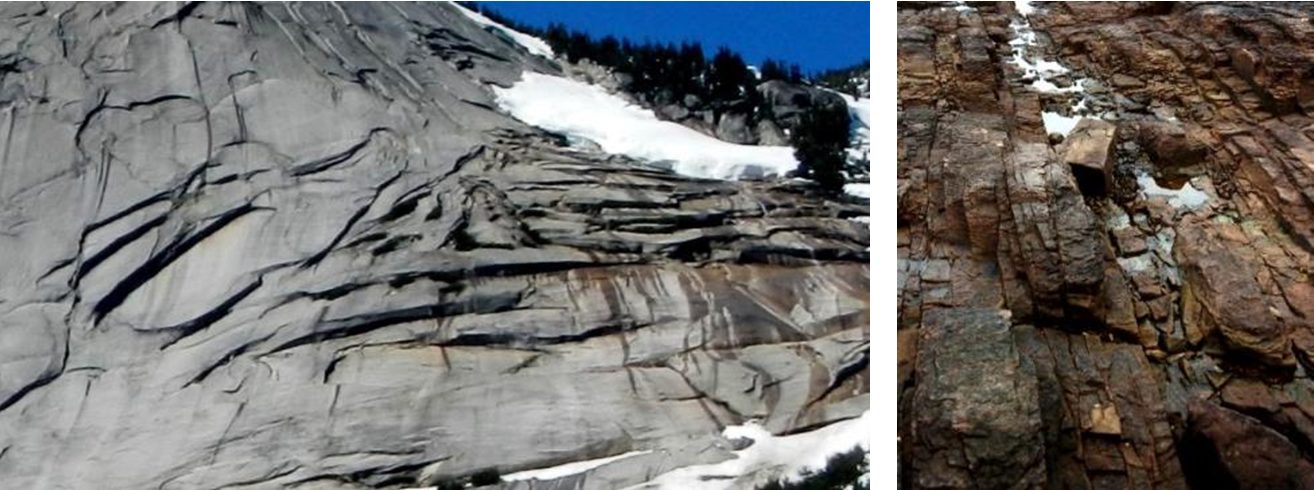
Figure. Relative stability of slopes as a function of the orientation of weaknesses (here bedding planes) relative to the slope. A and B — bedding nearly perpendicular to the slope — are stable; D — bedding nearly parallel to the slope — is unstable; C is intermediate. © Steven Earle, CC BY 4.0 — Physical Geology, 2nd ed., Fig. 15.1.2.
7.1.1 Movement of natural slopes
7.1.2 Movement of man-made slopes
7.2 The main movement types
7.2.1 Rockfall — rolling and falling of rock blocks
Rockfall is driven by frost wedging and unloading in steep, jointed rock. The weathered debris accumulates as a talus cone at the toe — a loose, poorly sorted and often metastable deposit, and itself a hazard if it is later cut or loaded.
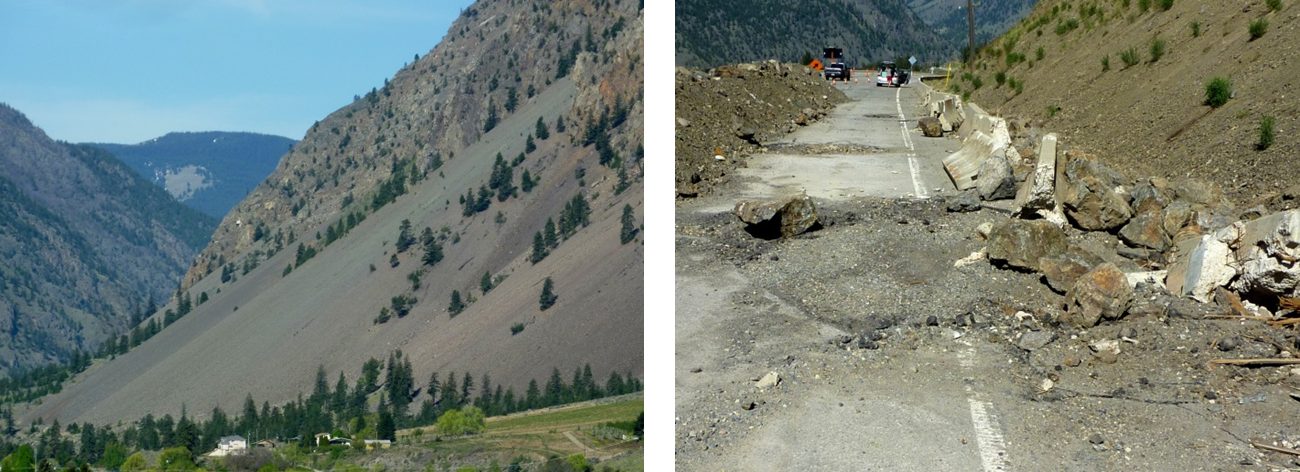
Figure. Left: a talus slope near Keremeos, B.C. Right: the result of a rock fall onto a highway west of Keremeos in December 2014 — the hazard rockfall monitoring is designed to catch. © Steven Earle, CC BY 4.0 — Physical Geology, 2nd ed., Fig. 15.2.2.
7.2.2 Sliding
Sliding is sub-divided by the shape of the failure surface:
- Plane sliding (trượt mặt phẳng)
- Simple circular sliding (trượt vòng cung đơn giản)
- Complex circular sliding (trượt vòng cung phức hợp)
7.2.3 Heave / lateral squeeze (trồi xệ) under load
7.2.4 Erosion and transport by flowing water
7.2.5 Cut slopes and fill slopes on incompressible ground
7.2.6 Fill slopes on compressible soft ground
7.2.7 Stability beneath a retaining wall
7.2.8 Creep and debris flow
Creep (trượt từ từ) is the slow, imperceptible downslope movement of soil and rock debris. It does not fail suddenly, but it is cumulative, and it is readable in the vegetation: trunks that are tilted and then turn upward again — pistol-butt trees — record years of creep on the slope.
A debris flow (dòng bùn đá) is the opposite — fast, water-charged and destructive. It travels in a steep channel as a slurry of water, mud, rock and vegetation, and it is the mechanism that turns a modest slope failure into a hazard to anything downslope.
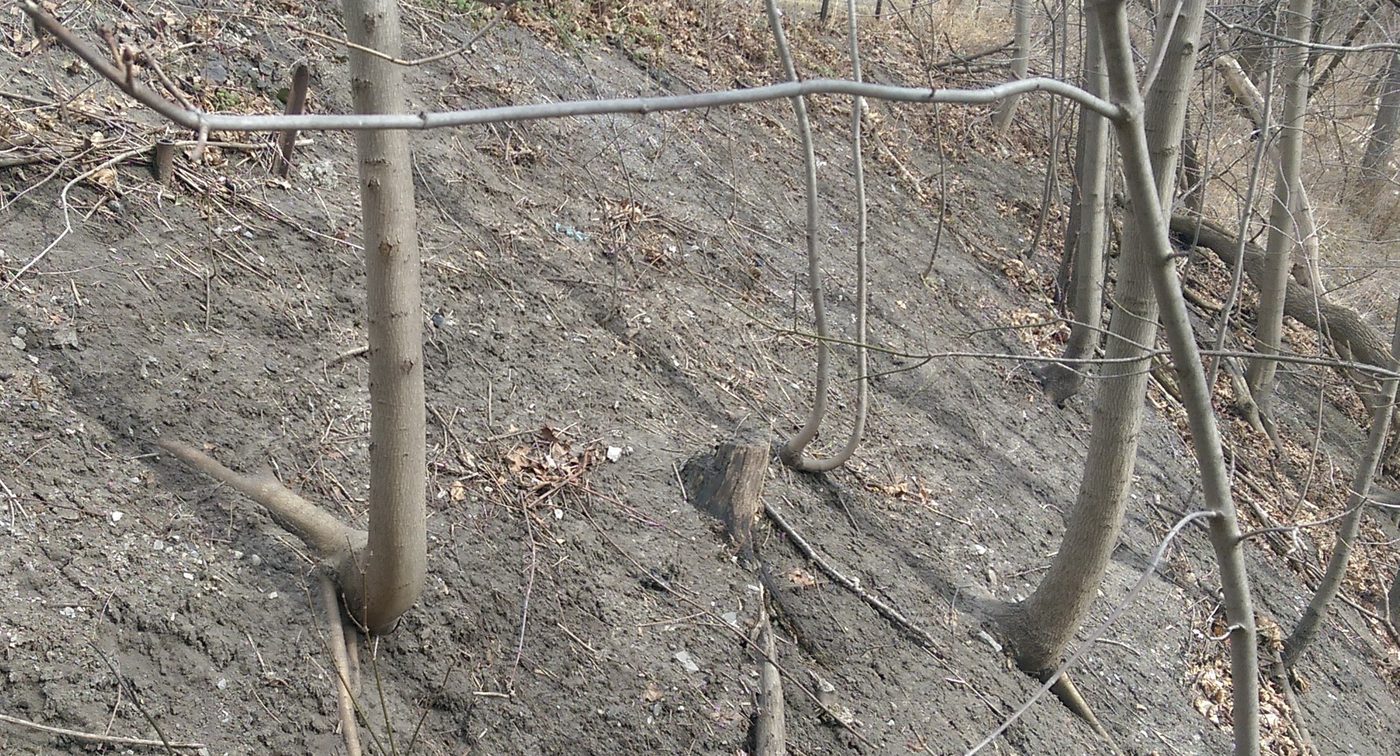
Figure. Pistol-butt shaped trees on a slope experiencing creep — a natural inclinometer. Vegetation tilt is one of the cheapest indicators a walk-over survey can read. © Steven Earle, CC BY 4.0 — Physical Geology, 2nd ed., Fig. 15.2.7.
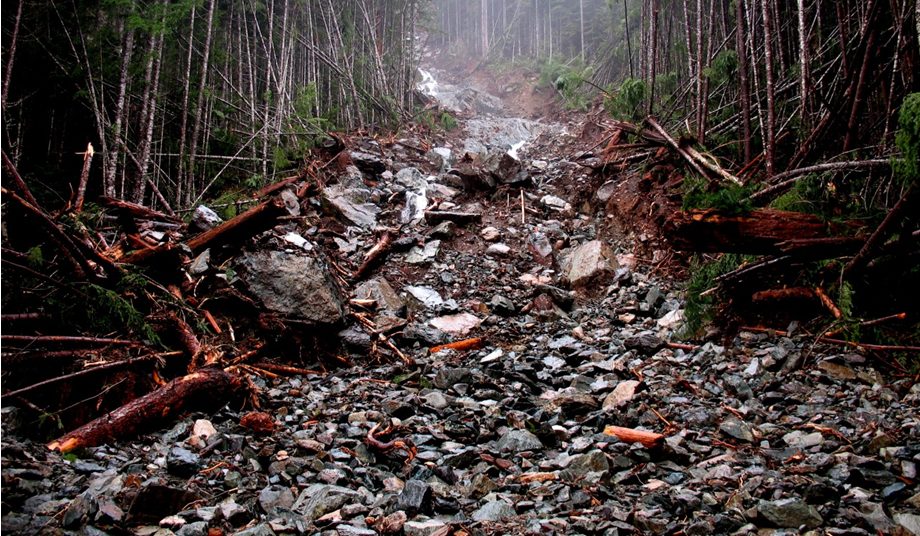
Figure. The lower part of a debris flow within a steep stream channel near Buttle Lake, B.C., November 2006. © Steven Earle, CC BY 4.0 — Physical Geology, 2nd ed., Fig. 15.2.11.
7.2.9 Two case examples
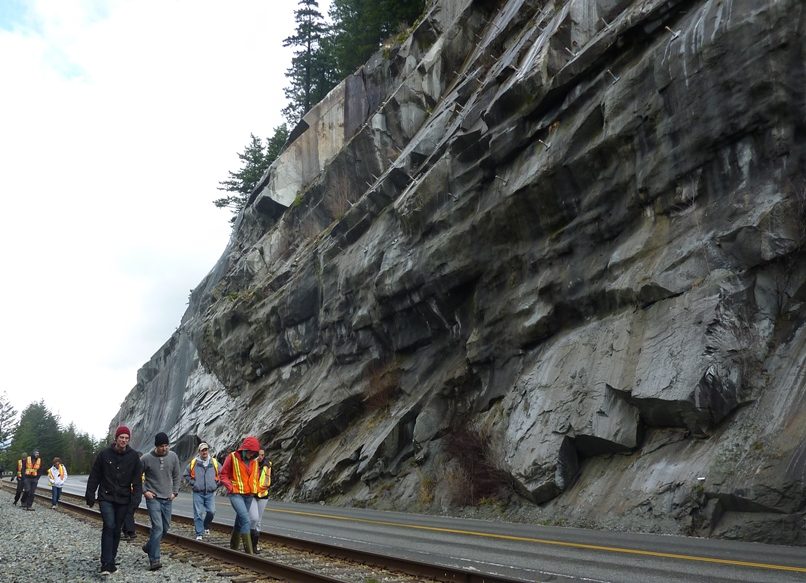
Figure. Site of the 2008 rock slide at Porteau Cove, B.C. — a rock slope in a transport corridor, where the consequence of failure is direct and immediate. © Steven Earle, CC BY 4.0 — Physical Geology, 2nd ed., Fig. 15.2.4.
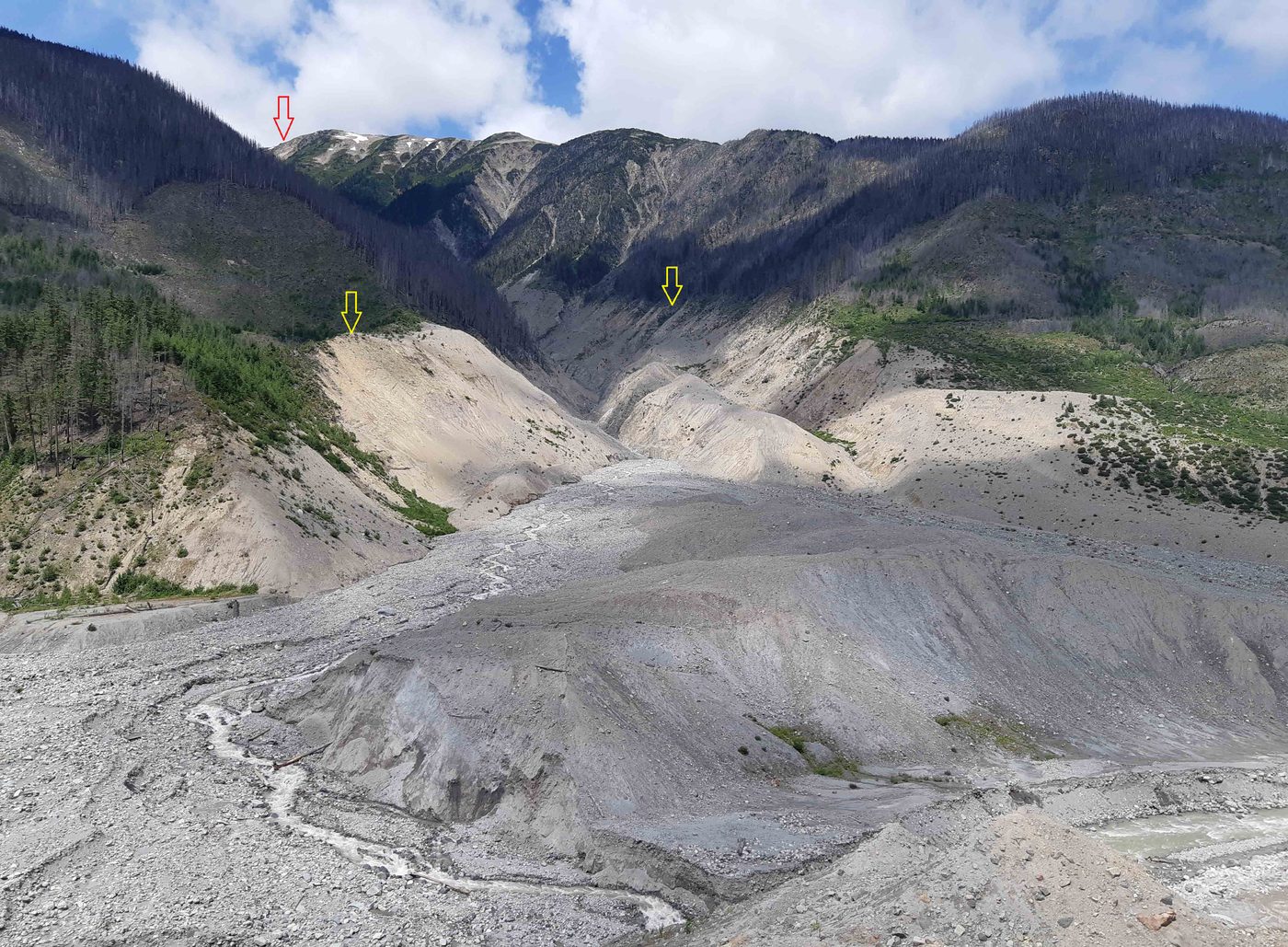
Figure. The August 2010 Mount Meager rock avalanche. A volcano flank collapsed and ran out down a steep narrow valley — the extreme end of the slope-failure spectrum, and a reminder that slope stability is not only a soil-mechanics problem. "2010 Mt. Meager rock avalanche" © Isaac Earle, CC BY 4.0 — Physical Geology, 2nd ed., Fig. 15.2.5.
7.3 Slope stability analysis
Every stability analysis comes down to the same comparison. Gravity pulls a block vertically down; that force resolves into a shear force pushing the block down the slope and a normal force pushing it into the slope. The slope holds if the available shear strength along the failure surface exceeds the shear force.
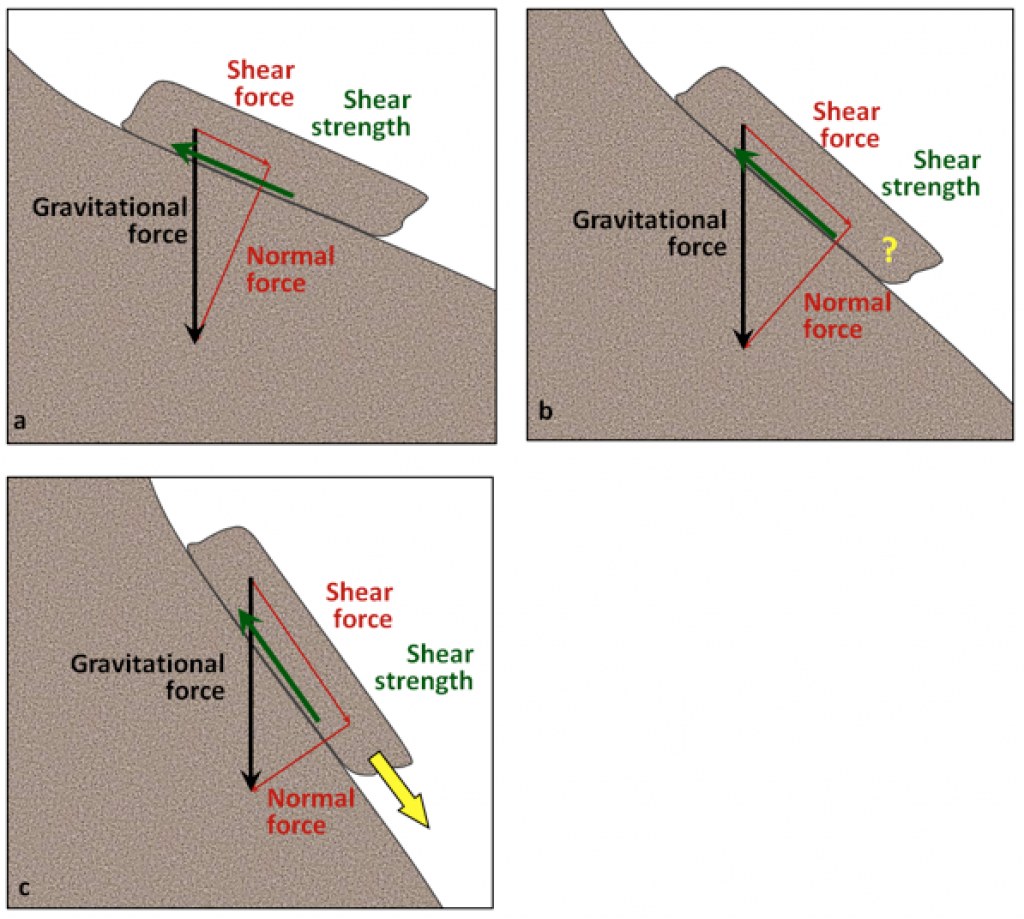
Figure. Shear and normal components of gravity on slopes of increasing steepness. The gravitational force is the same in all three cases; only its resolution changes. (a) shear force \(\ll\) shear strength — stable; (b) the two are about equal — marginal; © shear force \(\gg\) shear strength — failure. © Steven Earle, CC BY 4.0 — Physical Geology, 2nd ed., Fig. 15.1.1.
7.3.1 Analysis of plane sliding
7.3.2 Simple solutions
A family of simple solutions (charted or closed-form) for routine cases.
7.3.3 Analysis of circular-arc sliding
The circular-arc (Swedish / Fellenius) approach, in which the factor of safety is the ratio of resisting to driving moments about the centre of the trial circle. This is the method extended by Bishop in Chapter 9 for staged construction.
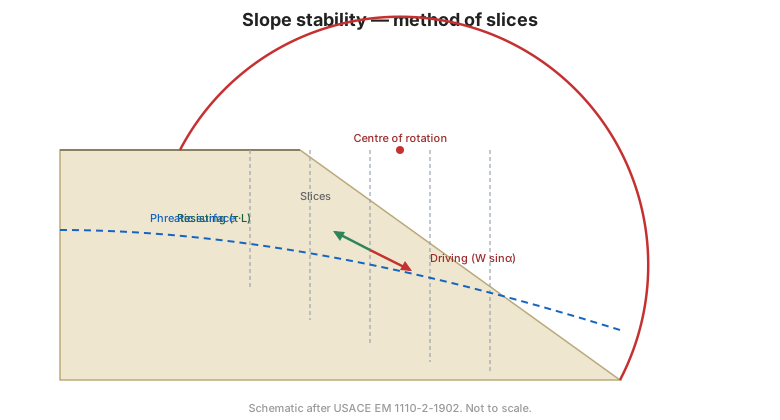
Figure. Circular-arc slope stability analysis.
7.4 Terminology
| English | Vietnamese (book) |
|---|---|
| natural / man-made slope | mái dốc tự nhiên / nhân tạo |
| slope stability | ổn định mái dốc |
| rockfall | lăn rơi khối đá |
| sliding | trượt |
| plane sliding | trượt mặt phẳng |
| circular-arc sliding | trượt cung tròn |
| heave / lateral squeeze | trồi xệ |
| cut slope | mái dốc đào |
| fill slope | mái dốc đắp |
| factor of safety | hệ số an toàn |
| failure surface | mặt trượt |
7.5 Key takeaways
- Slopes are natural or man-made; the failure mechanisms differ.
- Movements fall into rockfall, sliding, heave/squeeze, and water erosion.
- Sliding is classified by the shape of the failure surface — plane or circular arc.
- Exactly determining the factor of safety is hard; the work is in the soil characterisation and parameter choice, not just the arithmetic.
- The circular-arc method is the workhorse and leads into the Bishop method used for staged embankment construction in Chapter 9.