Chapter 15 — Mass Wasting
Mass wasting is the downslope movement of rock and soil under gravity. It is the geological view of slope stability — and it is useful precisely because it looks at the whole landscape rather than a single analysed section.
15.1 What controls slope stability
Two factors: the angle of the slope and the strength of the material on it. Gravity resolves into a shear force (down the slope) and a normal force (into the slope); the slope holds while shear strength exceeds shear force.
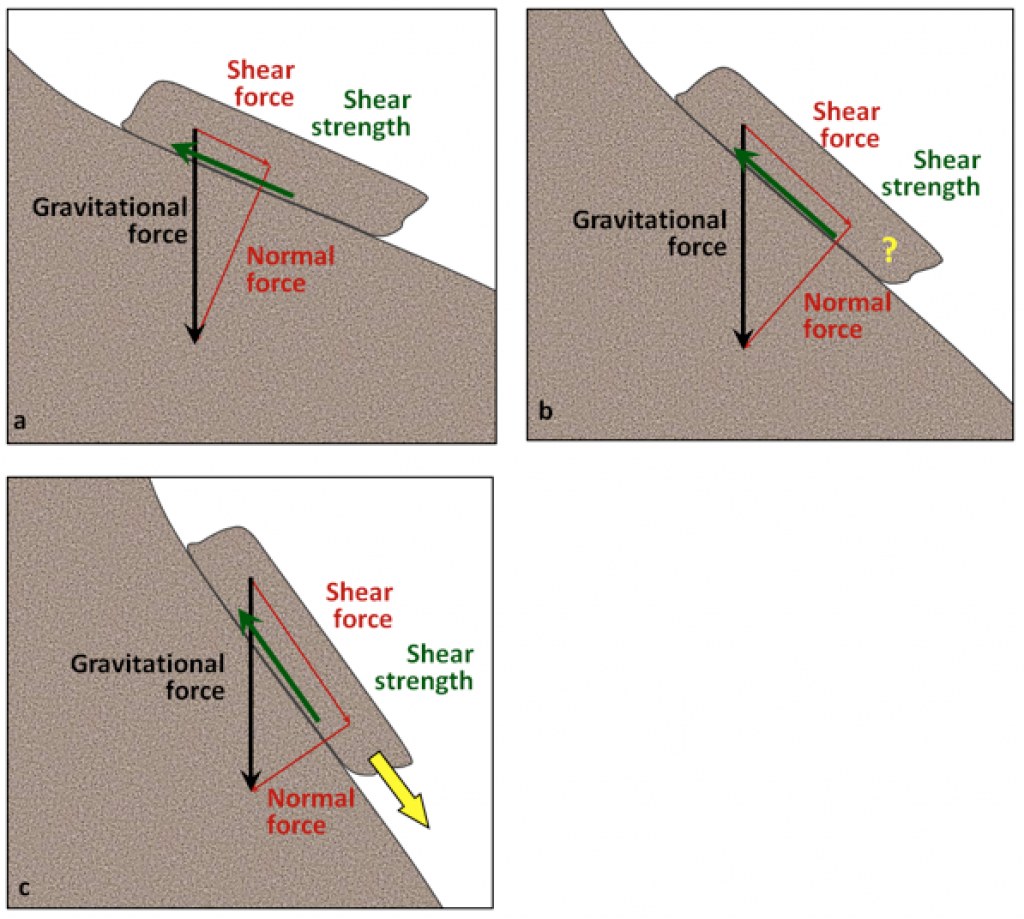
Figure. Shear and normal components of gravity on slopes of increasing steepness. (a) shear force much less than shear strength — stable; (b) about equal — marginal; © shear force much greater — failure. © Steven Earle, CC BY 4.0 — Physical Geology, 2nd ed., Fig. 15.1.1.
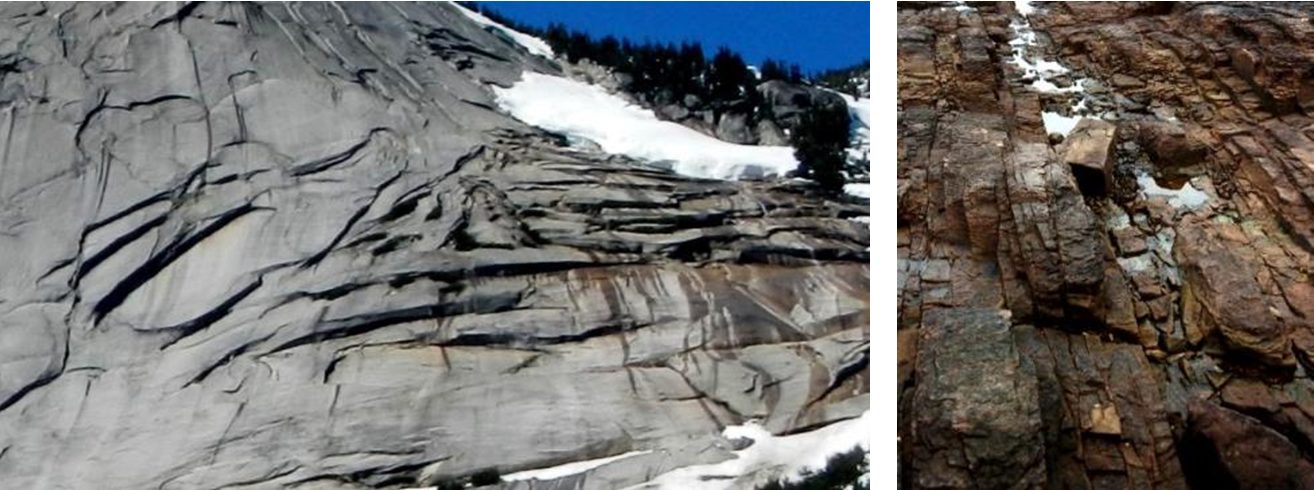
Figure. Relative stability of slopes as a function of the orientation of weaknesses (bedding planes) relative to the slope face. Parallel bedding is the most unstable case. © Steven Earle, CC BY 4.0 — Physical Geology, 2nd ed., Fig. 15.1.2.
Water — the dominant factor
The amount of water in the material is the most important control on its strength. This is especially true of unconsolidated material:
- Dry — held only by grain friction; weak if well sorted or rounded.
- Moist — strongest, because surface tension at grain contacts holds the grains together.
- Saturated — weakest, because water under pressure pushes the grains apart.
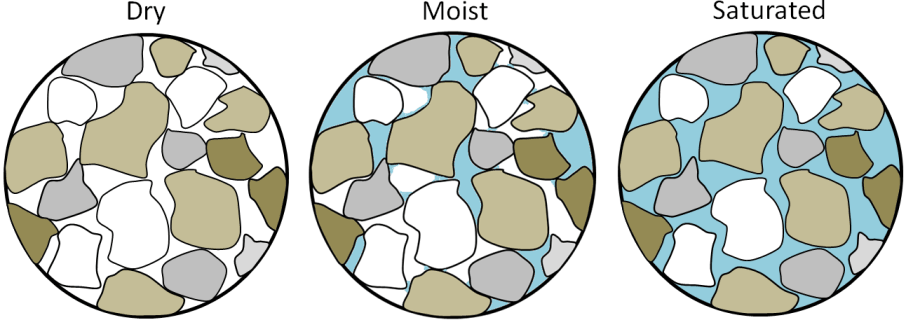
Figure. Dry, moist and saturated sand. Moist sand is the strongest; saturated sand the weakest. © Steven Earle, CC BY 4.0 — Physical Geology, 2nd ed., Fig. 15.1.4.
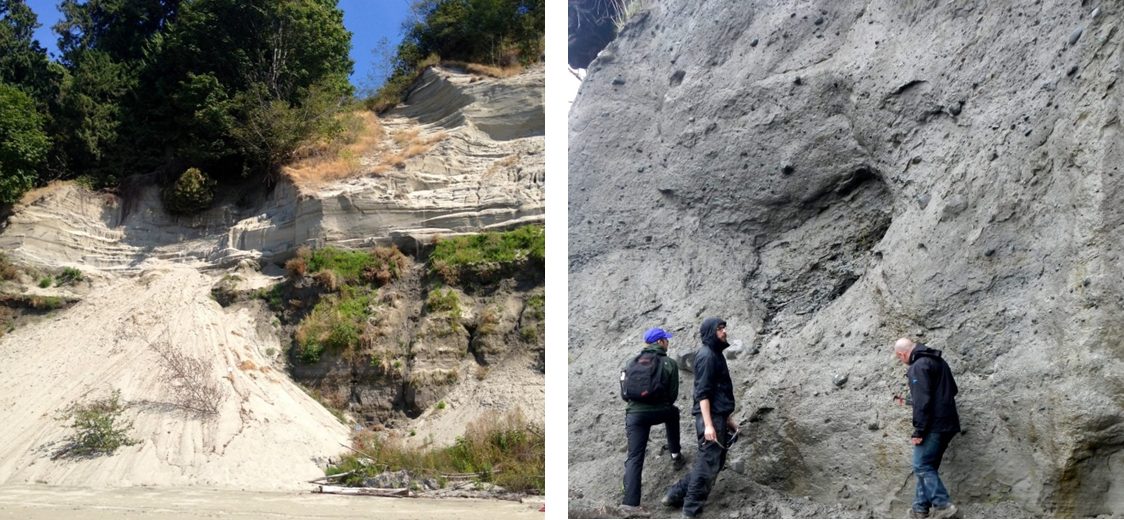
Figure. Left: glacial outwash at Point Grey, Vancouver — a strong lower layer beneath a weaker, recently failed sand. Right: glacial till on Quadra Island, B.C., strong enough to stand near-vertically. © Steven Earle, CC BY 4.0 — Physical Geology, 2nd ed., Fig. 15.1.3.
15.2 Types of mass wasting
Classified by material and speed:
- Rockfall — free fall of rock from a steep face; produces talus at the toe.
- Slump — rotational sliding of a coherent block.
- Slide — translational movement along a planar surface.
- Flow — debris flow, mudflow, earthflow; material moves as a fluid.
- Creep — extremely slow, imperceptible movement, readable in tilted vegetation.
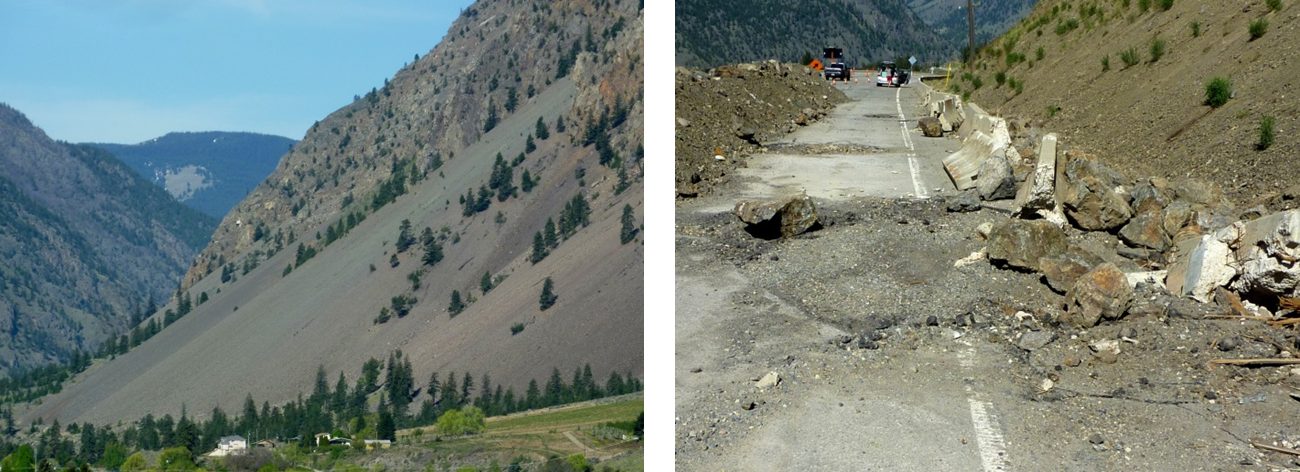
Figure. Left: a talus slope near Keremeos, B.C. Right: a rock fall onto a highway west of Keremeos, December 2014. © Steven Earle, CC BY 4.0 — Physical Geology, 2nd ed., Fig. 15.2.2.
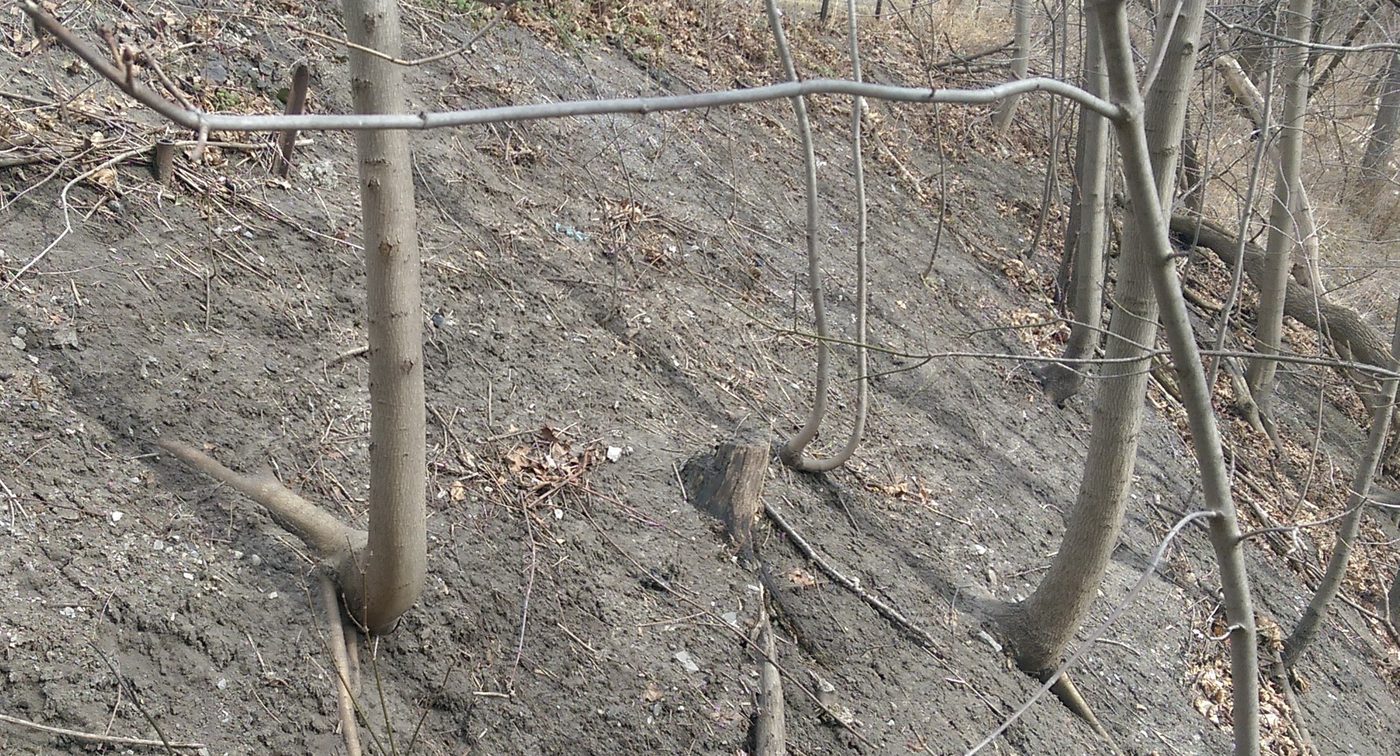
Figure. Pistol-butt shaped trees on a slope experiencing creep — a natural inclinometer, and one of the cheapest indicators a walk-over survey can read. © Steven Earle, CC BY 4.0 — Physical Geology, 2nd ed., Fig. 15.2.7.
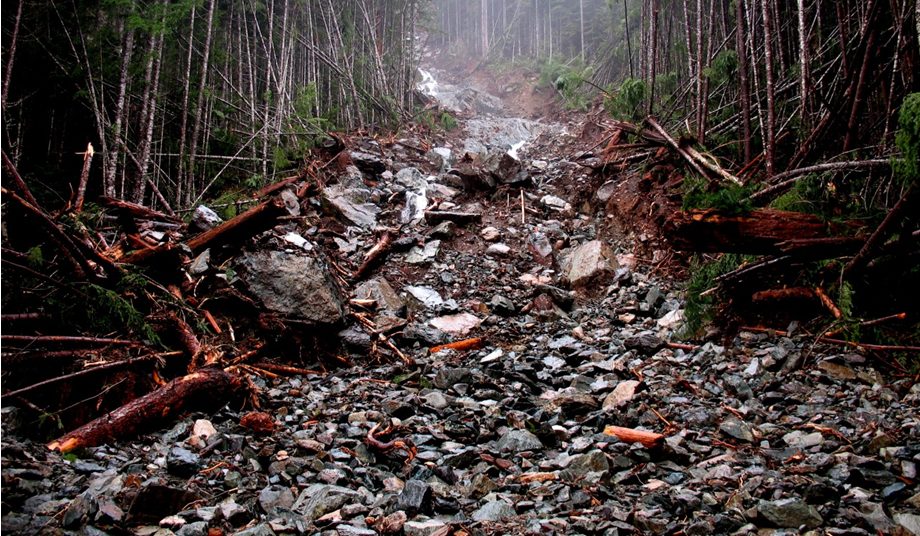
Figure. The lower part of a debris flow within a steep stream channel near Buttle Lake, B.C., November 2006. © Steven Earle, CC BY 4.0 — Physical Geology, 2nd ed., Fig. 15.2.11.
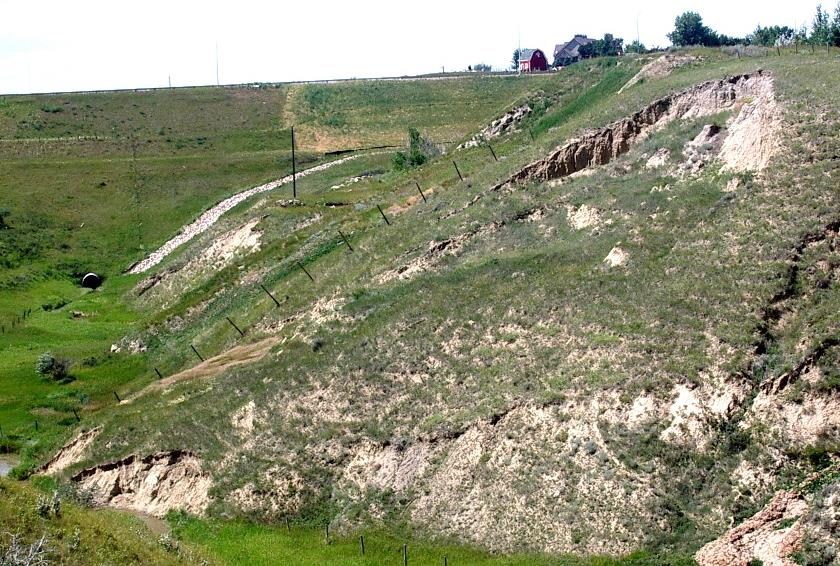
Figure. A slump along the banks of a small coulee near Lethbridge, Alberta. © Steven Earle, CC BY 4.0 — Physical Geology, 2nd ed., Fig. 15.2.9.
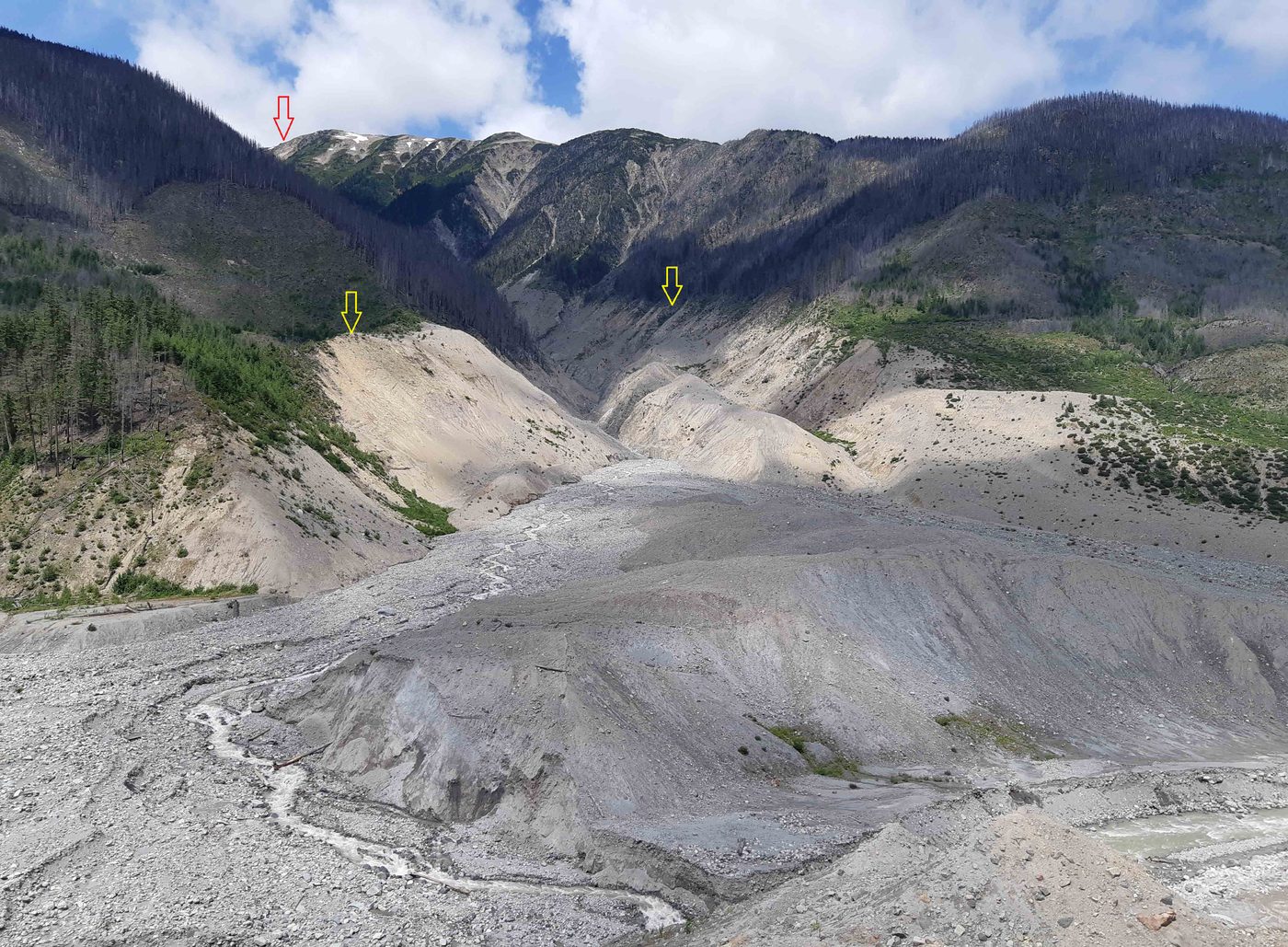
Figure. The August 2010 Mount Meager rock avalanche — the extreme end of the slope-failure spectrum. '2010 Mt. Meager rock avalanche' by Isaac Earle, CC BY 4.0 — Physical Geology, 2nd ed., Fig. 15.2.5.
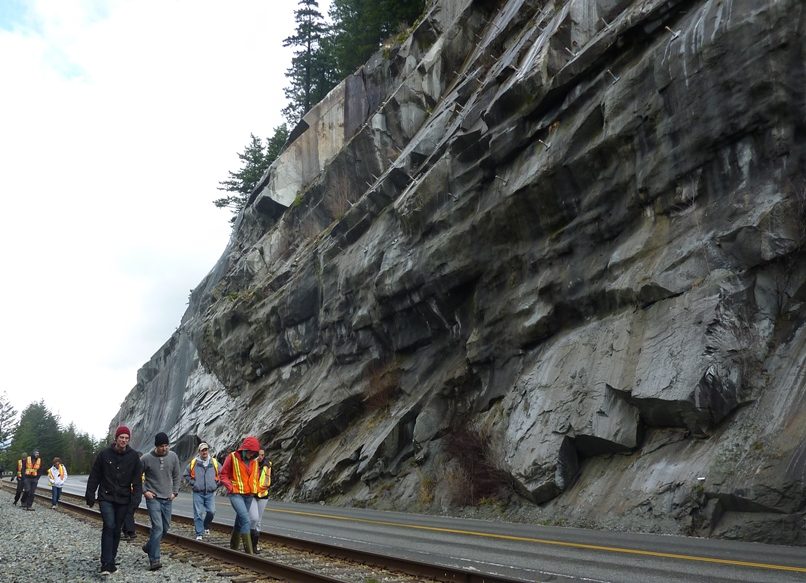
Figure. Site of the 2008 rock slide at Porteau Cove, B.C. — a rock slope in a transport corridor. © Steven Earle, CC BY 4.0 — Physical Geology, 2nd ed., Fig. 15.2.4.
15.3 Preventing, delaying and monitoring mass wasting
The standard measures are drainage (reduce pore pressure), regrading (reduce slope angle), retaining and reinforcement, and monitoring. Monitoring is the subject of the rest of this site — inclinometers, piezometers, extensometers and the rest — and its purpose is exactly to detect the movement described in this chapter early enough to act.
Key points for the geotechnical engineer
- Water is the dominant control on slope strength — drainage is usually the cheapest and most effective stabilisation measure.
- Orientation of weaknesses relative to the slope decides whether a slope can fail at all.
- Creep is a precursor, not a benign process — vegetation tilt and structural cracking are early warnings.
- Trigger = rapid loss of shear strength, most often from water, shaking or undercutting.
- Instrumentation exists to detect movement early — which is why slope monitoring and mass-wasting geology are the same subject seen from two directions.
Terminology
| English | Vietnamese |
|---|---|
| mass wasting | dịch chuyển khối (trượt lở) |
| shear force / shear strength | lực gây trượt / sức kháng cắt |
| rockfall / slump / slide / flow | lăn rơi / trượt xoay / trượt / dòng chảy |
| debris flow | dòng bùn đá |
| creep | trượt từ từ |
| trigger | nguyên nhân kích hoạt |
| talus / colluvium | taluy (tích tụ sườn) |
Digest of Chapter 15, Physical Geology – 2nd Edition, by Steven Earle (CC BY 4.0).