Chapter 9 — Consolidation
9.1 What consolidation is
Consolidation is the time-dependent volume change of a saturated fine-grained soil as excess pore pressure dissipates and the load transfers from the water to the solid skeleton. It is the mechanism behind the long-term settlement of clays and is governed by Terzaghi's one-dimensional consolidation theory.
9.2 The oedometer test
The one-dimensional consolidation test (oedometer) loads a confined sample in stages and records the compression with time. From it come:
- the compression index \(C_c\) (virgin compression slope);
- the recompression index \(C_r\) (unloading–reloading slope);
- the preconsolidation pressure \(\sigma'_p\) — the maximum past effective stress;
- the coefficient of consolidation \(c_v\) — the rate parameter.
9.3 Magnitude of settlement
For a normally consolidated clay, the primary consolidation settlement is:
For an over-consolidated clay, the recompression index is used up to \(\sigma'_p\), and \(C_c\) beyond it. The over-consolidation ratio \(OCR = \sigma'_p / \sigma'_{v0}\) tells whether the clay is NC (\(OCR=1\)) or OC (\(OCR>1\)).
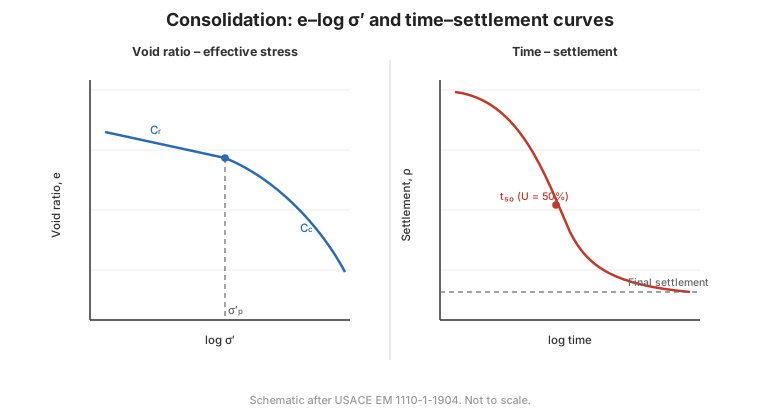
Figure. Consolidation: the e–log σ′ curve giving \(C_c\), \(C_r\), and the preconsolidation pressure, and the time–settlement curve from which \(c_v\) is derived (after USACE EM 1110-1-1904).
9.4 Rate of consolidation
The rate is governed by the coefficient of consolidation \(c_v\) and the drainage path length. The time factor \(T_v = c_v t / H_{dr}^2\) relates degree of consolidation \(U\) to time. Because \(H_{dr}\) appears squared, doubling the drainage path quadruples the time — the reason vertical drains (Chapter 14) accelerate consolidation so dramatically.
9.5 Secondary compression
After primary consolidation, secondary compression (creep) continues at roughly constant effective stress. It is significant in organic and soft clays and is described by the secondary compression index \(C_\alpha\). For some soils it dominates the long-term settlement.
9.6 Key takeaways
- Consolidation is time-dependent settlement from pore-pressure dissipation.
- The oedometer gives \(C_c\), \(C_r\), \(\sigma'_p\), and \(c_v\).
- Settlement magnitude follows the \(C_c\) / \(C_r\) logarithmic formula.
- Rate is governed by \(c_v\) and the drainage path (\(T_v = c_v t / H_{dr}^2\)).
- Secondary compression can dominate in organic soils.