Chapter 14 — Groundwater
Groundwater is stored in the voids of soil and rock. Two properties decide everything: how much space there is (porosity) and how well those spaces are connected (permeability).
14.1 Porosity
Porosity is the percentage of a material's volume that is void. Unconsolidated sediments are generally more porous than their consolidated equivalents, and finer materials (silt, clay) are more porous than coarser ones.
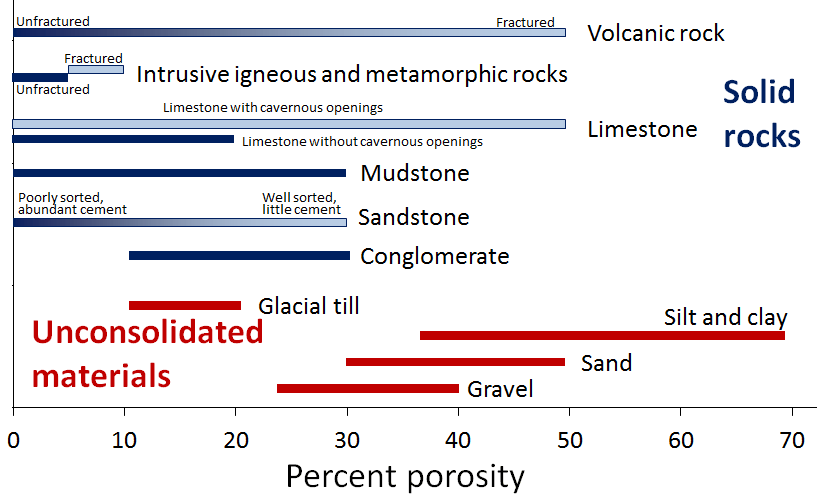
Figure. Typical porosity ranges for unconsolidated materials (red) and rocks (blue). Silt and clay are the most porous materials — yet the least permeable. © Steven Earle, CC BY 4.0 — Physical Geology, 2nd ed., Fig. 14.1.1.
14.2 Permeability and hydraulic conductivity
Permeability describes how well the pores are connected — and therefore how easily water flows. It is quantified as hydraulic conductivity \(K\), in metres per second.
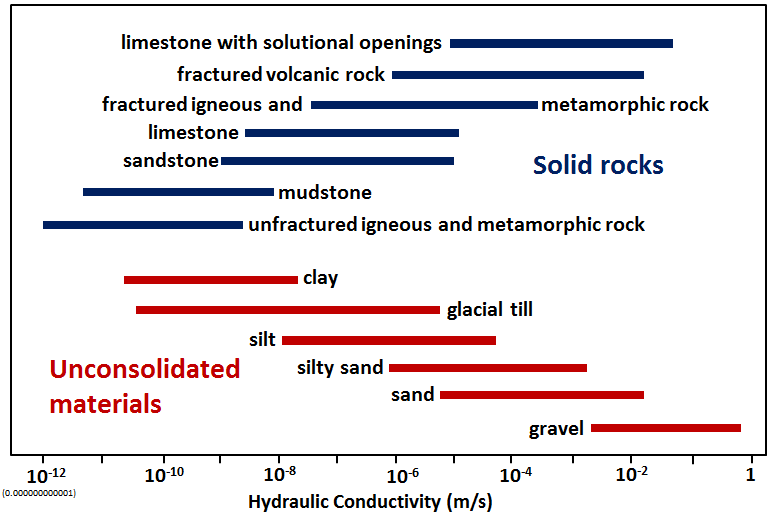
Figure. Hydraulic conductivity K (m/s) for unconsolidated materials (red) and rocks (blue) — a range of some twelve orders of magnitude. Clay is porous but nearly impermeable. © Steven Earle, CC BY 4.0 — Physical Geology, 2nd ed., Fig. 14.1.2.
The counter-intuitive but essential point: clay is porous but not permeable. Almost all of its water is held as bound water on the surfaces of the mineral grains and cannot flow. This is why a clay layer is a barrier, not a drain.
14.3 Aquifers and confining layers
- Aquifer — a body of ground that transmits water usefully.
- Aquitard / confining layer — a body that does not.
- Unconfined aquifer — open to the surface; the water table is its upper boundary.
- Confined aquifer — capped by a lower-permeability layer; its water is under pressure, so a piezometer reads above the top of the aquifer.
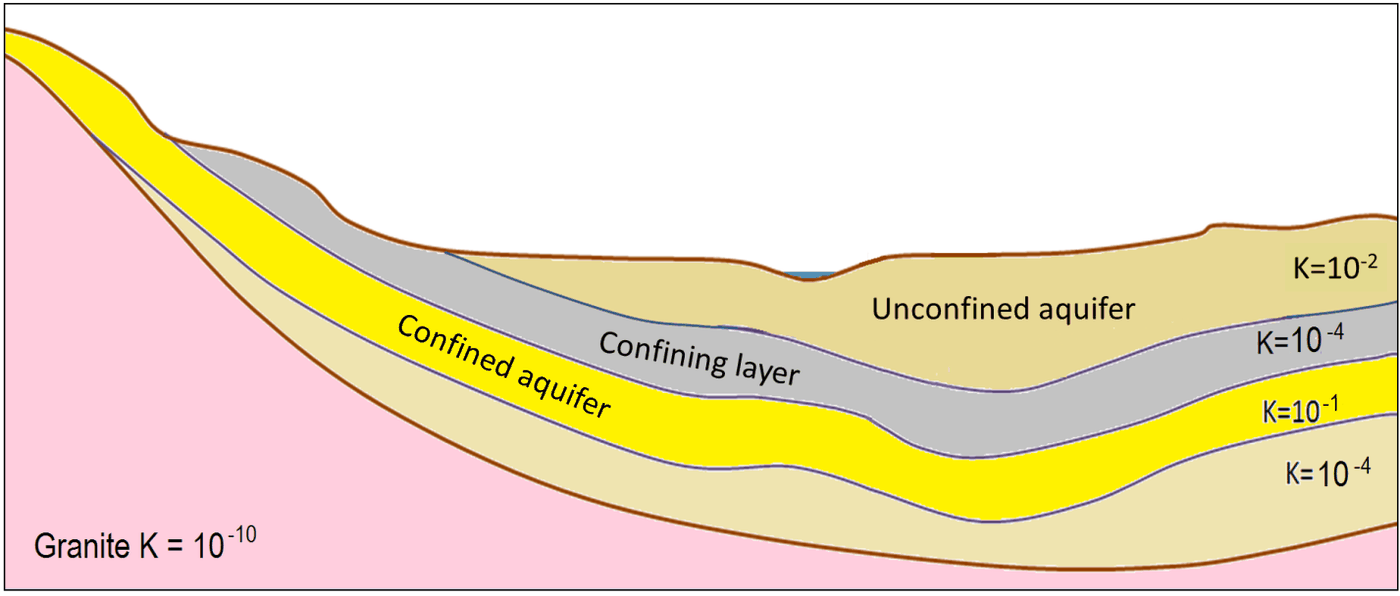
Figure. A cross-section of aquifers and confining layers, with relative permeabilities given as K (m/s). © Steven Earle, CC BY 4.0 — Physical Geology, 2nd ed., Fig. 14.1.4.
14.4 Groundwater extraction and quality
Pumping changes the water table and creates drawdown, which causes settlement — a classic cause of damage to structures near wells and deep excavations. Groundwater quality also matters: aggressive groundwater corrodes steel and attacks concrete.
Key points for the geotechnical engineer
- Porosity ≠ permeability. Clay is the proof.
- Hydraulic conductivity spans 12 orders of magnitude — the single most important number in any seepage or drainage calculation.
- Confined aquifers are under pressure; the piezometric level is not the water table.
- Pumping causes settlement — drawdown is a geotechnical, not just a water-supply, issue.
- Groundwater chemistry drives corrosion and concrete attack.
Terminology
| English | Vietnamese |
|---|---|
| porosity | độ rỗng |
| permeability / hydraulic conductivity | tính thấm / hệ số thấm |
| aquifer / aquitard | tầng chứa nước / tầng cách nước |
| unconfined / confined aquifer | tầng không áp / tầng có áp |
| water table | mực nước ngầm |
| drawdown | hạ thấp mực nước |
| bound water | nước liên kết |
Digest of Chapter 14, Physical Geology – 2nd Edition, by Steven Earle (CC BY 4.0).