Chapter 2 — Engineering Properties of Foundation Soils
Chapter II is the soil-mechanics core of the handbook. It defines what "foundation soil" means, then builds up from the three phases of soil to the physical indices, and finally to the mechanical theories a designer needs.
2.1 What "construction soil" means
Soil (đất xây dựng) is a three-phase system: solid particles (hạt rắn), water (nước) and gas/air (khí).
- If water fills every void, the soil is saturated (bão hoà).
- If the voids hold only air, the soil is dry (khô).
- If a void holds air but is sealed off from the atmosphere, that air is occluded (khí bị nhốt).
Solid particles form the skeleton (khung cốt liệu) of the soil. Special soils — organic soil, peat, mud — contain organic matter that decomposes over time, giving them very high compressibility and low strength.
2.2 Soil structure
2.2.1 Classification of solid particles
The handbook uses the British Standard (BS) grain-size classification:
| Fraction | Grain size \(D\) |
|---|---|
| Boulders / cobbles (tảng, hòn) | \(D > 200\) mm |
| Gravel (cuội sỏi) | \(20 < D < 200\) mm |
| Coarse gravel / shingle (dăm sạn) | \(2 < D < 20\) mm |
| Sand (cát) | \(0.06 < D < 2\) mm |
| Silt (bụi) | \(0.002 < D < 0.06\) mm |
| Clay (sét) | \(D < 0.002\) mm |
Other systems place the clay/silt boundary at 0.005 mm or 0.002 mm, and the silt/sand boundary at 0.075 mm or 0.06 mm — the boundaries are conventional. Beyond size, two further factors matter: grain shape (rounded, angular, sub-rounded) and the mineral composition of the particles.
2.2.2 Pore water and soil fabric
Water in the voids, and the way particles are arranged into a fabric, control compressibility, permeability and strength.
2.3 Physical properties
2.3.1 The physical indices
Water content \(w\), void ratio \(e\), porosity \(n\), unit weights \(\gamma\), \(\gamma_d\), \(\gamma_{sat}\), specific gravity \(G_s\) — the standard index set.
2.3.2 Relationships between the indices
The indices are not independent: the handbook sets out the closed set of relationships (phase relationships) that lets any index be derived from a few measured ones. These are the same identities tabulated in the site's Soil Mechanics reference.
2.4 Mechanical properties in outline
2.4.1 Elastic theory applied to soil
Soil is treated as an elastic half-space to obtain stress distributions.
2.4.2 Stress around a point — the Mohr circle
The state of stress at a point is represented by the Mohr circle (vòng tròn Mohr), which gives the normal and shear stress on any plane through the point. This is the basis of the strength criterion used throughout the book.
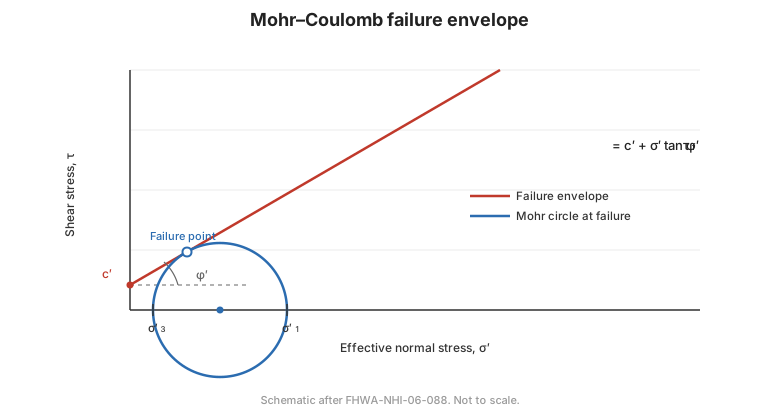
Figure. Mohr–Coulomb failure envelope and Mohr circle (after FHWA-NHI-06-088).
2.4.3 Plastic-deformation theory for soil
Beyond the elastic range, soil deforms plastically; the handbook outlines the plasticity framework used to describe yielding and failure.
2.4.4 Soil and Terzaghi's consolidation theory
Consolidation (cố kết) is the time-dependent compression of a saturated soil as excess pore pressure dissipates and effective stress increases. Terzaghi's one- dimensional theory is the foundation of settlement-versus-time prediction.
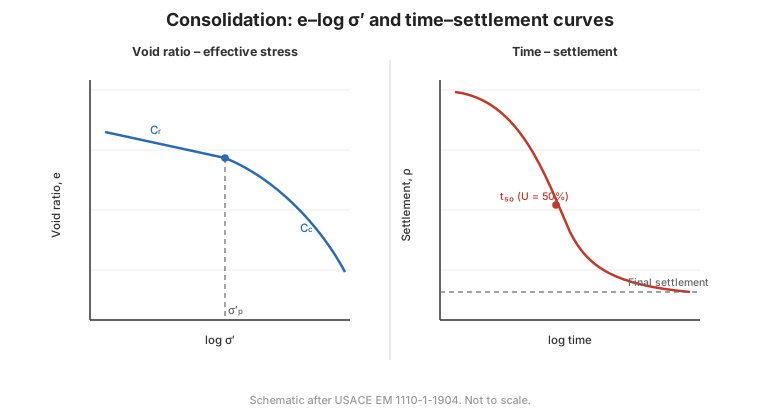
Figure. Consolidation: \(e\)–\(\log\sigma'\) curve and the time–settlement curve (after USACE EM 1110-1-1904).
2.4.5 Menard's theory for the pressuremeter test
The pressuremeter (nén ngang) expands a cylindrical probe in the borehole and measures the pressure–volume response; Menard's theory converts that response into a pressuremeter modulus \(E_p\) and a limit pressure \(P_l\) — inputs used later for foundation and settlement analysis (Chapters 5–6).
2.5 Terminology
| English | Vietnamese (book) |
|---|---|
| three-phase system | hệ ba thành phần (hạt rắn, nước, khí) |
| saturated / dry soil | đất bão hoà / đất khô |
| occluded air | khí bị nhốt |
| soil skeleton | khung cốt liệu |
| grain-size distribution | phân loại hạt (theo cỡ hạt) |
| water content | độ ẩm |
| void ratio | hệ số rỗng |
| porosity | độ rỗng |
| unit weight (bulk / dry / saturated) | dung trọng (tự nhiên / khô / bão hoà) |
| specific gravity | tỷ trọng |
| Mohr circle | vòng tròn Mohr |
| consolidation | cố kết |
| effective stress | ứng suất hữu hiệu |
| pressuremeter modulus | mô đun nén ngang |
2.6 Key takeaways
- Soil is a three-phase system; the solid skeleton carries the load and the pore water carries the pressure.
- Grain-size boundaries are conventional — the BS set is used here.
- The physical indices form a closed set of relationships; a few measurements give the rest.
- The Mohr circle expresses stress at a point; the Mohr–Coulomb envelope gives strength.
- Terzaghi consolidation explains settlement over time; Menard's theory turns the pressuremeter curve into design parameters.