Chapter 14 — Ground Improvement & Foundation Instrumentation
14.1 Why improve the ground
When the ground cannot support the proposed foundation economically, it can be improved in place rather than bypassed with deep foundations. Ground improvement increases strength, reduces compressibility, controls groundwater, or mitigates liquefaction. It is often the most economical solution for weak, loose, or compressible soils.
14.2 Densification methods
- Vibro-compaction and vibro-replacement (stone columns) — vibratory probes densify loose sands and form columns of compacted stone in soft clays.
- Dynamic compaction — a heavy weight dropped in a grid densifies granular fill and loose soils.
- Deep dynamic replacement — stone or rubble columns formed by dropping.
- Compaction grouting — stiff grout injected to densify and lift.
14.3 Reinforcement and inclusion
- Stone columns — increase bearing capacity and reduce settlement; also act as drains.
- Soil nailing — steel nails installed into a slope or excavation face to reinforce it (FHWA GEC-7).
- Reinforced soil (MSE) — geosynthetic or metallic reinforcement in fill (Chapter 11).
- Micropiles — small-diameter drilled and grouted piles for restricted access or underpinning.
14.4 Grouting and drainage
- Permeation grouting — fills voids in granular soils to reduce permeability and increase strength.
- Jet grouting — high-pressure grout creates soil–cement columns.
- Drainage — vertical drains, wick drains, and horizontal drains accelerate consolidation and lower pore pressures.
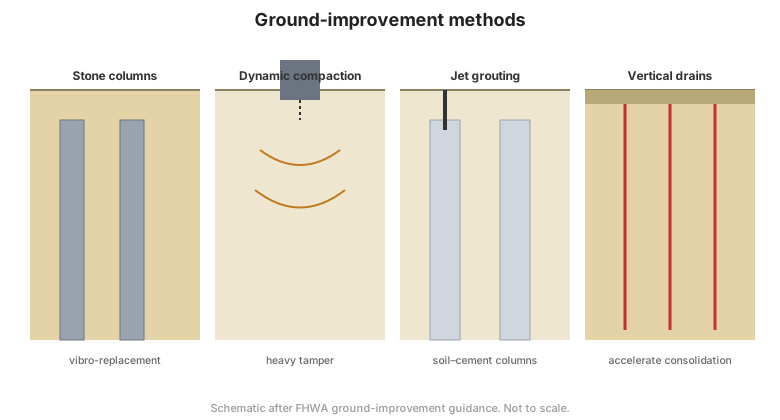
Figure. Common ground-improvement methods: vibro-replacement / stone columns, dynamic compaction, jet grouting, and prefabricated vertical drains (after FHWA ground-improvement guidance).
14.5 Instrumentation for foundations
Because ground improvement and deep foundations are expensive and difficult to verify, instrumentation is essential to confirm performance:
- Settlement platforms and extensometers — measure settlement and its distribution.
- Piezometers — track pore pressures during consolidation and loading.
- Inclinometers — detect lateral movement in slopes and behind excavations.
- Load cells and strain gages — measure load in piles, anchors, and struts.
- Settlement and heave points — verify ground improvement and adjacent structures.
These instruments, and the practice of using them, are covered in depth in the Dunnicliff and FHWA references.
14.6 Key takeaways
- Ground improvement is often cheaper than deep foundations for weak ground.
- Densification (vibro, dynamic compaction) treats loose and compressible soils.
- Inclusion and reinforcement (stone columns, soil nails, MSE, micropiles) add strength and stiffness.
- Grouting and drainage control permeability and pore pressure.
- Instrument every improvement and foundation — verification is essential because the ground is hidden.