Chapter 2 — Subsurface Exploration & Site Characterization
2.1 Why explore
Every foundation design is only as good as the ground model behind it. Subsurface exploration establishes the stratigraphy, groundwater conditions, and engineering properties needed to select a foundation type and compute capacity and settlement. Under-exploration is the most common root cause of foundation problems.
2.2 The exploration programme
A programme is planned around the structure and the questions it raises:
- Purpose — what loads, what tolerable movement, what construction methods?
- Layout — boreholes and soundings positioned to cover the structure footprint and any variability; more closely spaced where conditions change.
- Depth — deep enough to pass through all layers that contribute significantly to settlement, or to reach competent bearing strata.
- Methods — a combination of boreholes with sampling and in-situ tests.
2.3 Sampling and in-situ testing
- Boreholes recover disturbed and undisturbed samples for laboratory testing.
- The Standard Penetration Test (SPT) gives the blow count \(N\) — a widely used index of density and strength, and the basis of many empirical correlations.
- The Cone Penetration Test (CPT) gives continuous tip resistance and sleeve friction, excellent for profiling soft soils and estimating strength and consolidation parameters.
- Vane shear, pressuremeter, and dilatometer tests provide specific parameters in situ.
2.4 Groundwater
Groundwater governs effective stress and therefore strength and settlement. Establish:
- the depth to the water table and its seasonal range;
- pore pressures and any artesian conditions;
- the permeability of each layer, for seepage and consolidation.
Pore pressures are measured with piezometers (see the Dunnicliff and FHWA references).
2.5 From data to a design profile
Exploration produces a design profile: a simplified, conservative model of the layers, their properties, and the groundwater regime, expressed as parameters for the analyses in the following chapters. The profile should:
- bound uncertainty — adopt conservative values where data are sparse;
- identify problem soils — soft clays, loose sands, expansive or collapsible soils, organics, fill;
- flag variability — where properties change sharply across the site.
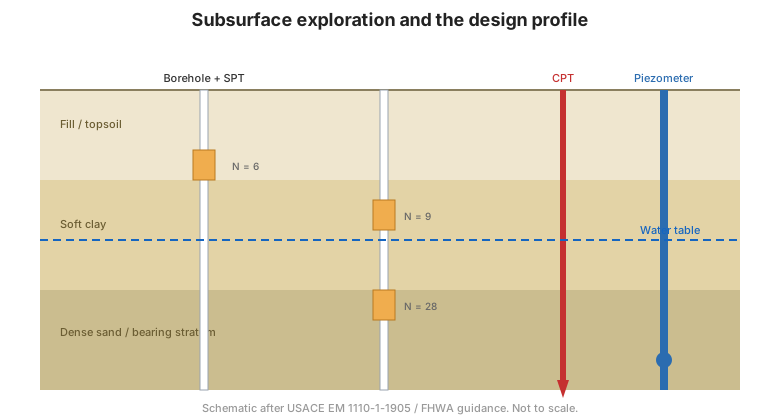
Figure. Subsurface exploration: boreholes with sampling and in-situ tests, plus piezometers, build the design profile (after USACE EM 1110-1-1905 / FHWA guidance).
2.6 Key takeaways
- Explore before you design — the ground model drives every decision.
- Combine boreholes with in-situ tests (SPT, CPT) and groundwater measurement.
- Depth and spacing follow the structure and its questions.
- Reduce the data to a conservative, clearly-stated design profile.
- Watch for problem soils and variability.