Chapter 6 — Seepage & Flow Nets
6.1 Seepage and its consequences
Seepage is the flow of water through soil under a hydraulic gradient. It matters because it:
- exerts seepage forces on the soil skeleton, reducing stability;
- causes uplift pressures on structures;
- can trigger piping and internal erosion, the mechanism of many dam and levee failures; and
- drives consolidation and the rate of settlement.
6.2 Flow nets
A flow net is a graphical solution of Laplace's equation for steady seepage. It consists of two orthogonal families of curves:
- Flow lines — the paths along which water travels; and
- Equipotential lines — lines of equal total head.
The net is drawn so that the elements are "square". From it, the engineer reads:
- the quantity of seepage \(q = k H (N_f / N_d)\);
- the pore pressure (and thus uplift) at any point;
- the exit gradient at the downstream surface, which governs piping.
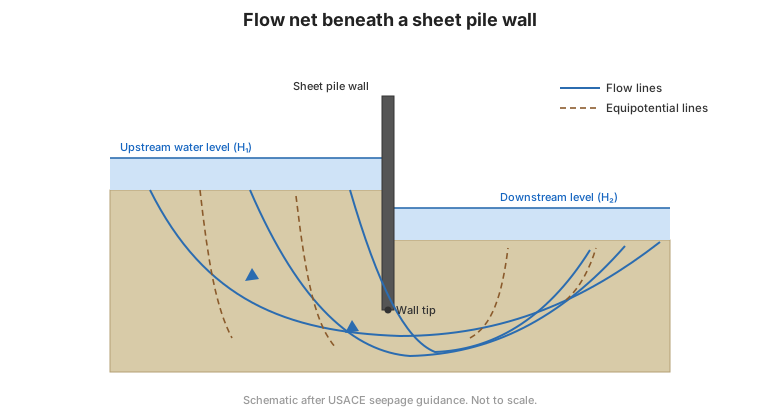
Figure. A flow net beneath a sheet pile wall: flow lines and equipotential lines give seepage quantity, uplift, and exit gradient (after USACE seepage guidance).
6.3 Uplift and buoyancy
Water pressure acts upward on a structure or soil mass, reducing effective stress. Under a dam or floor slab, the uplift pressure is read from the flow net and must be resisted by the structure's weight. Where uplift reduces effective stress to zero, the soil floats and loses all strength.
6.4 Piping and internal erosion
Piping occurs when the exit gradient at the downstream surface exceeds a critical value, so that water lifts and carries away soil particles, forming a pipe that progresses backward and can cause collapse. The factor of safety against piping compares the critical gradient (often ~1.0, or lower for safety) with the actual exit gradient.
Mitigation includes:
- longer seepage paths (cut-off walls, blankets);
- filters and drains that intercept and safely discharge seepage; and
- relief wells to control uplift.
6.5 Filters and drainage
Filters protect against internal erosion by allowing water to pass while retaining soil particles. Design follows filter criteria (the filter must be coarse enough to be permeable and fine enough to retain the protected soil). Drainage layers and geotextiles perform the same function.
6.6 Key takeaways
- Seepage forces reduce stability and cause uplift.
- A flow net gives seepage quantity, pore pressure, and exit gradient.
- Piping occurs when the exit gradient is too high — check a factor of safety.
- Filters and drains are the standard protection against internal erosion.
- Seepage drives consolidation and must be managed in design.