Chapter 7 — Seepage and Phreatic-Surface Monitoring
7.1 Seepage: friend and foe
Some seepage is normal at a tailings facility; uncontrolled or changing seepage is a leading indicator of internal erosion (piping) and over-saturation. The surveillance task is to quantify seepage and detect change.
7.2 What to measure
- Location and clarity — where seepage emerges and whether it is clear or turbid (turbidity can signal internal erosion).
- Discharge — volume per unit time, via V-notch weirs, flumes, or flow meters.
- Temperature and chemistry — can distinguish sources and detect leaks from decants or pipelines.
- Phreatic surface — the level of the water table within the deposit and embankment, tracked by piezometers (Chapter 6).
7.3 Beach geometry and the phreatic surface
The beach is the gently sloping surface where slurry is deposited. Its geometry controls where the phreatic surface sits. A well-run facility keeps the phreatic surface low and within the beach, far from the crest, by managing deposition and decant. Monitoring includes:
- Beach slope and length (survey, drone photogrammetry).
- Phreatic-surface elevation from piezometers and observation wells.
- Freeboard — the vertical distance from the pond to the crest.
Beach management is surveillance
A short or flat beach pushes the phreatic surface toward the embankment and reduces freeboard — a direct path to liquefaction and overtopping. Beach geometry is not just operations; it is a safety parameter.
7.4 Detecting internal erosion (piping)
Piping is insidious because it can develop inside the embankment. Warning signs:
- New or increasing seepage, especially turbid or sandy discharge.
- Seepage emerging at unexpected locations (toe, downstream slope).
- Settlement or small depressions over a seepage path.
- A sudden increase in discharge without a corresponding pond rise.
7.5 Instruments and methods
- Weirs and flumes for total seepage quantity.
- Piezometers and observation wells for phreatic surface.
- Visual surveillance for location, clarity, and turbidity (Chapter 3).
- Decant monitoring to confirm pond level and freeboard.
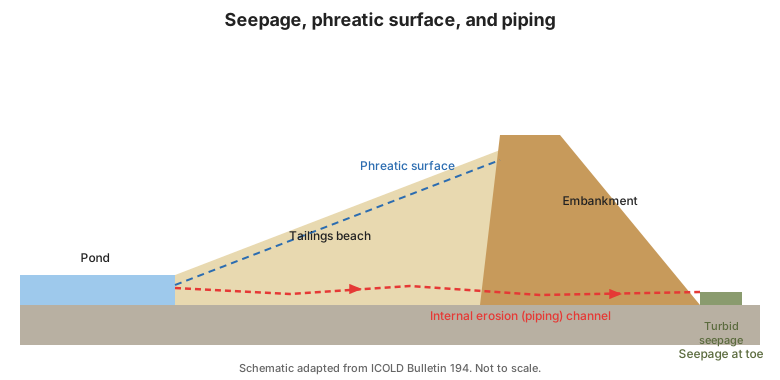
Figure. Seepage, phreatic surface, and piping (internal erosion). Turbid seepage at the downstream toe is a warning sign (ICOLD Bulletin 194).
7.6 Key takeaways
- Quantify seepage and watch for change, especially turbidity.
- Keep the phreatic surface low and within the beach; protect freeboard.
- Beach geometry is a safety parameter, not just operations.
- Piping announces itself through new, turbid, or increasing seepage.