Chapter 8 — Retaining Wall Analysis
Chapter VIII covers earth pressures and the structures that resist them. It opens with the classical active and passive pressure theory, then treats rigid walls (gravity and cantilever) and flexible walls (sheet piles and diaphragm walls), including anchored walls and braced excavations.
8.1 Active and passive pressure
8.1.1 Cohesive soil (\(\varphi = 0\), \(c \neq 0\))
For a vertical wall with a horizontal backfill surface, ignoring wall–soil friction, the active pressure (áp lực chủ động) is the minimum lateral pressure the soil exerts on the wall — the condition in which the wall has moved away enough for the soil to mobilise its shear strength along the failure plane:
where \(\sigma'_z\) is the effective vertical stress, \(c\) is the cohesion, and \(K_a\) is the coefficient of active earth pressure.
1. The coefficient \(K_a\) is found from:
2. The active thrust \(Q_a\) for a wall of height \(H\) is:
and its point of application is at \(\tfrac{1}{3}H\) from the base of the wall.
8.1.2 Granular soil
The same framework with \(c = 0\), plus the effect of wall friction and sloping backfill.
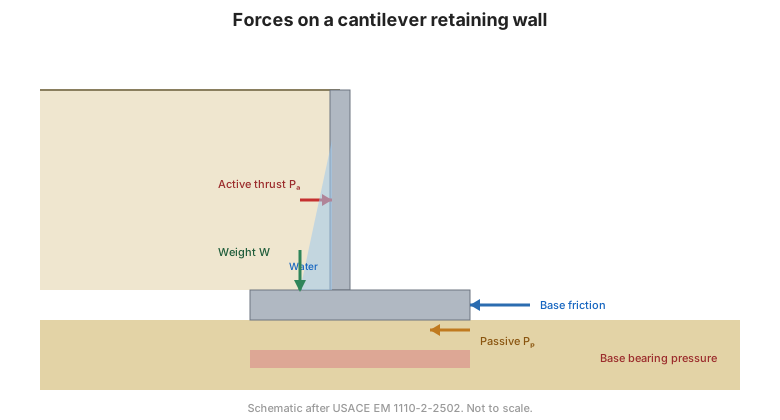
Figure. Earth pressures acting on a retaining wall.
8.2 Rigid retaining wall analysis
8.2.1 Definition and classification
Gravity, semi-gravity and cantilever walls.
8.2.2 Analysis of a rigid wall
Stability against overturning, sliding and bearing failure, plus internal structural design.
8.2.3 Some types of low rigid wall
8.3 Flexible retaining wall analysis
8.3.1 Definition and classification
Sheet piles and diaphragm (slurry) walls.
8.3.2 Analysis of a cantilever (fixed-base) wall
8.3.3 Analysis of an anchored wall
8.3.4 Analysis of a braced excavation
Braced excavations (hố đào với tường chống xà) — the case most relevant to urban deep excavation and to the instrumentation in this site's Foundation & Excavation page.
8.3.5 Base stability and wall deformation of an excavation
8.4 Terminology
| English | Vietnamese (book) |
|---|---|
| retaining wall | tường chắn |
| active earth pressure | áp lực chủ động |
| passive earth pressure | áp lực bị động |
| earth pressure at rest | áp lực tĩnh (nghỉ) |
| coefficient of active earth pressure | hệ số áp lực chủ động |
| active thrust | lực chủ động |
| rigid wall | tường chắn cứng |
| flexible wall | tường chắn mềm |
| cantilever wall | tường công-xôn |
| sheet pile | tường cừ |
| anchored wall | tường chắn có neo |
| braced excavation | hố đào chống xà |
8.5 Key takeaways
- Active pressure is the minimum; passive is the maximum; at rest is between.
- For cohesive soil, \(\sigma_a = K_a\sigma'_z - 2c\sqrt{K_a}\) and \(K_a = \tan^2(45^\circ - \varphi/2)\).
- The active thrust on a wall of height \(H\) is \(Q_a = \tfrac{1}{2}K_a\gamma H^2\), acting at \(\tfrac{1}{3}H\) above the base.
- Rigid walls are checked for overturning, sliding and bearing.
- Flexible walls (sheet pile, diaphragm) and braced excavations are the critical case for urban deep excavation monitoring.