Chapter 3 — Shallow Foundations: Bearing Capacity
3.1 The bearing-capacity problem
A shallow foundation (typically a footing with depth \(D_f\) less than its width \(B\)) must transfer the structural load to the ground without shear failure of the supporting soil. The ultimate bearing capacity \(q_{ult}\) is the pressure at which the soil fails; the allowable bearing pressure is \(q_{ult}\) divided by a factor of safety, also checked against settlement (Chapter 4).
3.2 Failure modes
Bearing failure occurs in one of three ways, depending on soil density and compressibility:
- General shear — a well-defined wedge and slip surface; a sudden, brittle failure. Typical of dense sands and stiff clays.
- Local shear — a less developed slip surface with significant settlement before failure. Typical of medium-dense soils.
- Punching shear — the footing punches into the soil with little surface heave. Typical of loose sands and soft clays.
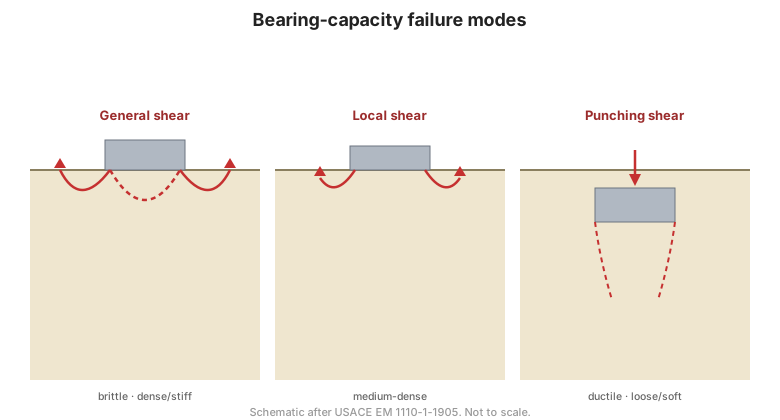
Figure. Bearing-capacity failure modes: general shear (brittle), local shear, and punching shear (ductile) (after USACE EM 1110-1-1905).
3.3 The bearing-capacity equation
The classical solution expresses \(q_{ult}\) as a sum of three terms:
where \(c\) is cohesion, \(q\) is the surcharge at foundation level, \(\gamma\) is the unit weight, \(B\) is the footing width, \(N_c, N_q, N_\gamma\) are bearing-capacity factors (functions of the friction angle), and the \(s\) terms are shape factors. Several formulations are in use — Terzaghi, Meyerhof, Hansen, and Vesić — differing in the factors and in how they treat shape, depth, inclination, and eccentricity.
3.4 The water table
Groundwater reduces the effective stress in the failure zone, lowering capacity. The two extremes are:
- water table at the base of the footing, and
- water table at the ground surface.
In between, the unit weight terms are reduced by a factor depending on the depth of the water table relative to \(B\). The design must use the highest anticipated water level for the critical (lowest) capacity.
3.5 Eccentric and inclined loads
Real footings carry eccentric loads (moments) and sometimes inclined loads. The standard approach is to replace the actual footing with an effective area \(B' \times L'\) (Meyerhof), centred under the load resultant, and to apply inclination factors. Eccentricity reduces both the effective bearing area and the capacity.
3.6 Bearing capacity from in-situ tests
Where samples are difficult, capacity is estimated from field tests:
- SPT — correlations between \(N\) and allowable pressure, adjusted for water table and overburden.
- CPT — capacity from cone tip resistance.
- Plate load test — a direct, in-situ measurement of the load–settlement response of the actual soil, extrapolated to the prototype footing with care.
3.7 Key takeaways
- Ultimate capacity ÷ factor of safety = allowable pressure — but settlement often governs.
- Know the failure mode: general, local, or punching shear.
- The capacity equation is three terms (cohesion, surcharge, self-weight) with shape/depth/inclination factors.
- Use the highest water table in the design.
- Convert eccentric loads to an effective area.
- Plate load tests measure real soil response; use them with judgment.