Chapter 6 — Systematic Approach to Planning Monitoring Programs
6.1 Introduction
Planning is the hub of a successful monitoring program. The FHWA manual organizes it as a disciplined sequence of steps, each of which is a link in the chain of 31 (21 planning + 10 execution). Skipping a step weakens the chain. The process begins with a definition of the objective and ends only when the data are implemented — that is, used to make a decision.
The planning steps below correspond to Table 1-1 of the manual.
6.2 The 21 planning steps (Phase I)
- Define the project conditions — geometry, stratigraphy, groundwater, loading, and construction sequence.
- Predict mechanisms that control behavior — what physical processes will govern the response (e.g., consolidation, shear, seepage)?
- Define the geotechnical questions that need to be answered — the questions drive everything that follows.
- Define the purpose of the instrumentation — what decision will the data inform?
- Select the parameters to be monitored — the quantities that answer the questions.
- Predict magnitudes of change — expected values set the required range, resolution, and accuracy.
- Devise remedial action — decide in advance what will be done if thresholds are exceeded.
- Assign tasks — for design, construction, and operation phases; use a task assignment chart.
- Select instruments — matched to parameter, range, and ground conditions.
- Select instrument locations — where the measurement best answers the question.
- Plan recording of factors that may influence measured data — weather, construction activity, load, temperature.
- Establish procedures for ensuring reading correctness — calibration, checks, and cross-checks.
- List the specific purpose of each instrument — the golden rule, written down.
- Prepare a budget.
- Prepare the instrumentation system design report.
- Write instrument procurement specifications.
- Plan installation.
- Plan regular calibration and maintenance.
- Plan data collection, processing, presentation, interpretation, reporting, and implementation.
- Write specifications for field instrumentation services.
- Update the budget.
6.3 The 10 execution steps (Phase II)
- Procure instruments.
- Perform pre-installation acceptance tests.
- Install instruments.
- Perform post-installation acceptance tests.
- Calibrate and maintain instruments.
- Collect data.
- Process and present data.
- Interpret data.
- Report conclusions.
- Implement — act on the conclusions.
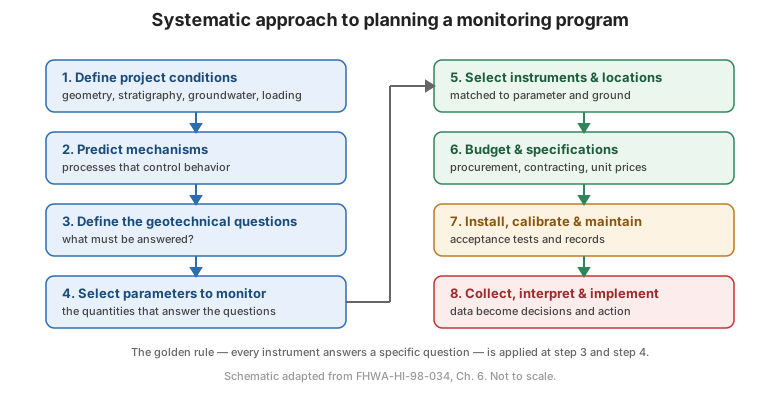
Figure. The systematic planning workflow: define conditions → predict mechanisms → define questions → select parameters → select instruments and locations → budget and specify → install → collect, process, interpret, and implement (after FHWA-HI-98-034, Ch. 6).
6.4 Specifications and contracting
Procurement is part of planning, not an afterthought. The manual gives contents for:
- Low-bid specifications for procurement of instrumentation materials.
- Low-bid specifications for field instrumentation services.
- Possible unit-price payment items.
Clear specifications — covering calibration, acceptance testing, installation tolerances, and documentation — are what make the difference between a system that works and one that quietly fails.
6.5 The golden rule, applied
At Step 13, every instrument must have a written, specific purpose. This is the golden rule of Chapter 1 turned into a planning deliverable: if you cannot write the question the instrument answers, delete the instrument.
6.6 Key takeaways
- Planning is a sequence of 21 steps; execution adds 10 more.
- Questions come first — parameters, instruments, and locations all follow.
- Predict magnitudes to set the required range and resolution.
- Decide the remedial action before you need it.
- Specifications and budgets are part of planning.
- Write down the purpose of every instrument — no question, no instrument.