Chapter 4 — Overview of Hardware for Total Stress in Soil
4.1 Introduction
Total stress is the sum of effective stress and pore pressure (\(\sigma = \sigma' + u\)). Because pore pressure is measured separately with piezometers (Chapter 2), measuring total stress lets the engineer separate the two and obtain effective stress — the quantity that actually governs strength and deformation. Total stress in soil is measured with earth pressure cells.
4.2 Embedment earth pressure cells
An embedment earth pressure cell is a flat, fluid- or diaphragm-filled pad embedded in the soil that measures the total stress acting normal to its face.
4.2.1 Typical cells
The cell consists of two plates welded at the edges with a thin layer of fluid between them; total stress deflects the plates and is read by a pressure transducer (frequently vibrating-wire). The cell must be embedded so that the soil acts on it as it would on the surrounding ground.
4.2.2 Limitations imposed by the soil environment
Because a cell is stiffer or softer than the soil around it, it redistributes stress locally, so the cell measures a stress that may differ from the true free-field value. This is the central problem of earth pressure measurement.
4.2.3 Factors affecting measurements
The main factors are:
- the aspect ratio (diameter-to-thickness ratio) of the cell,
- the ratio of soil stiffness to cell stiffness,
- the quality of placement and backfill around the cell, and
- temperature and calibration effects.
A high aspect ratio and a cell stiffness matched to the soil both reduce the error.
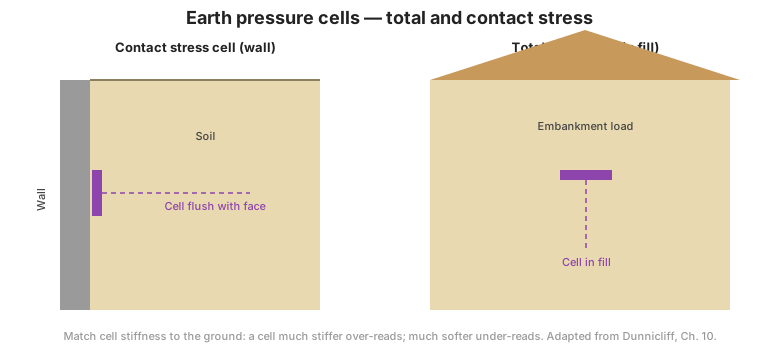
Figure. Embedment earth pressure cell: a flat cell with a transducer reads the total stress normal to its face; placement and stiffness matching control accuracy (after FHWA-HI-98-034, Ch. 4).
4.3 Contact earth pressure cells
A contact earth pressure cell measures stress (or load) at an interface — the contact between soil and a structure, or at the base of a foundation element. Variants include:
- Standard contact cells — soil/structure interface stress.
- Cells for load at the toe of driven piles — placed at the pile tip.
- Cells for load at the base of drilled shafts — mounted between thick circular plates.
- Cells for stress on the sides of driven piles — to separate shaft friction from end bearing.
- Cells for measuring stress on the sides of drilled shafts and other contact surfaces.
Because the structure's stiffness differs from the soil's, contact cells also require careful placement and interpretation.
4.4 Key takeaways
- Total stress + pore pressure = effective stress. Measuring both separates the strength-controlling quantity.
- Earth pressure cells redistribute local stress; a mismatch in stiffness causes error.
- Aspect ratio and soil/cell stiffness ratio are the two key design factors for embedment cells.
- Contact cells resolve stress at interfaces and at pile toes and shaft bases.
- Placement quality is as important as the instrument itself.