Chapter 9 — Instrumentation for Earth Retaining Structures
9.1 Introduction
Earth retaining structures hold back soil or rock and transfer the resulting loads to the ground or to internal reinforcement. Instrumentation confirms that the structure is behaving as designed — that movements are small, loads are as predicted, and the ground behind the wall is stable. This chapter covers braced excavations, slurry walls, mechanically stabilized earth (MSE) walls, and soil nailing walls.
9.2 Internally braced excavations
General role. Instrumentation monitors wall movement, ground movement, strut loads, and pore pressures around an excavation, so that bracing can be adjusted and adjacent structures protected.
Principal geotechnical questions:
- How much is the wall and the surrounding ground moving?
- What loads are the struts carrying?
- Is the base heaving or is pore pressure building?
Suitable instruments (Table 9-1) typically include: inclinometers (wall and ground movement), load cells (strut loads), piezometers (pore pressure), settlement points, and survey.
9.3 Externally braced excavations
General role. For anchored or tie-back systems, instrumentation measures anchor loads and ground movement.
Suitable instruments (Table 9-2) typically include: load cells (anchor loads), inclinometers, piezometers, and survey points.
9.4 Slurry walls
General role. Instrumentation confirms the stability of the trench during construction and the performance of the completed wall.
Suitable instruments (Table 9-3) typically include: convergence gages (trench stability), inclinometers (wall movement), and stress/strain and pressure instruments.
9.5 Mechanically stabilized earth (MSE) walls
General role. Instrumentation measures the stresses and strains in the reinforcement and the movement of the facing and the retained soil.
Principal geotechnical questions:
- What tension is mobilized in the reinforcement?
- How much does the wall face and the retained soil move?
- What stresses act at the base?
Suitable instruments (Table 9-4) typically include: strain gages / load cells on the reinforcement, inclinometers and survey for movement, and pressure cells at the base.
9.6 Soil nailing walls
General role. Instrumentation measures nail loads, facing movement, and ground deformation.
Suitable instruments (Table 9-5) typically include: load cells on nails, inclinometers, and survey points.
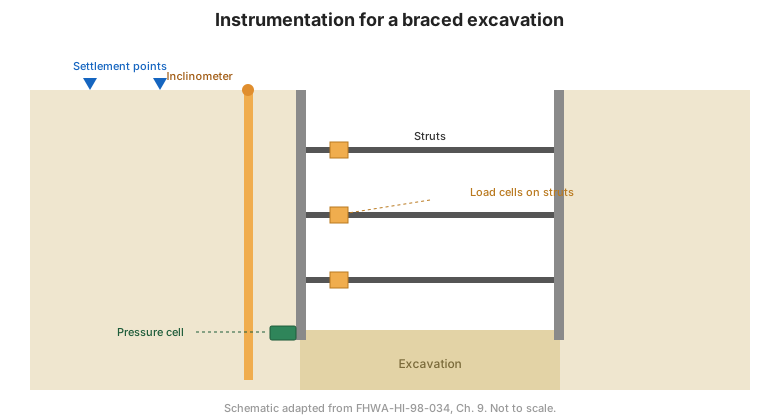
Figure. Instrumentation for an earth retaining structure: inclinometers behind the wall, load cells on struts/anchors, pressure cells at the base, and settlement points on adjacent ground (after FHWA-HI-98-034, Ch. 9).
9.7 Student exercise — MSE wall
The manual includes a student exercise on a mechanically stabilized earth wall, covering comprehensive stability monitoring and the determination of the magnitude and distribution of stress in the wall. Example results are in Appendix E (see Chapter 14).
9.8 Key takeaways
- Match the instrument to the load path: struts/anchors → load cells; wall/ground → inclinometers and survey; ground → piezometers.
- For MSE walls, instrument the reinforcement to see the mobilized tension.
- Protect adjacent structures by monitoring ground movement outside the excavation.
- Worked MSE-wall examples are in Appendix E.