Chapter 4 — Compaction
4.1 What compaction is
Compaction is the densification of soil by removing air voids through mechanical effort — rolling, tamping, or vibration. It increases dry unit weight, and with it strength and stiffness, while reducing permeability and compressibility. It does not remove water, so compaction and consolidation are different processes.
4.2 The moisture–density relationship
For a given compactive effort, there is an optimum water content \(w_{opt}\) at which the soil reaches its maximum dry unit weight \(\gamma_{d,max}\):
- Dry of optimum — the soil is stiff and hard to compact; the particles resist rearrangement.
- Wet of optimum — water lubricates the particles but fills the voids; density falls again.
The compaction curve (dry unit weight vs. water content) is the basis of field control.
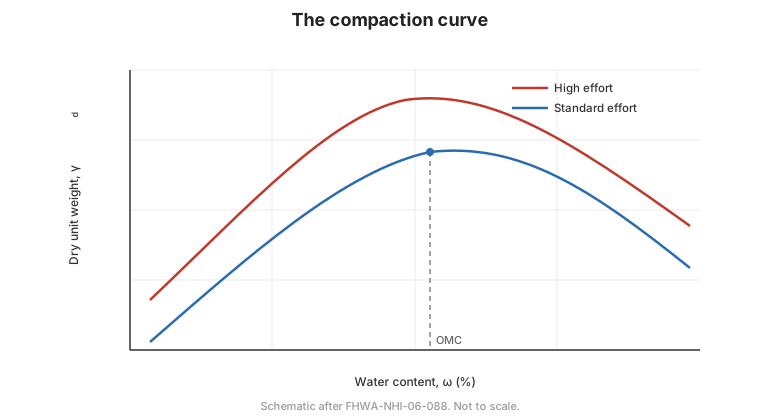
Figure. The compaction curve: dry unit weight peaks at the optimum water content; higher compactive effort raises the curve (after FHWA-NHI-06-088).
4.3 Standard and modified Proctor
Two standard laboratory efforts are used:
- Standard Proctor — lower energy; used for most fills and embankments.
- Modified Proctor — higher energy (heavier hammer, greater drop); used for heavily loaded fills, airfields, and pavements.
Higher energy gives a higher maximum dry unit weight and a lower optimum water content.
4.4 Field control
Field compaction is controlled by specifying a percentage of the maximum dry unit weight (e.g. 95% of Standard Proctor) and a moisture range around optimum. Verification uses:
- Field density tests — sand-cone, balloon, or nuclear gauge; and
- Moisture content — oven, speedy, or nuclear.
4.5 Compaction, structure, and behaviour
Compaction is not just about density:
- Compacted dry of optimum — flocculated structure, higher permeability and stiffness, lower strength at high strain.
- Compacted wet of optimum — dispersed structure, lower permeability, higher strength, but more shrinkage potential.
- The method (kneading vs. static) also changes the structure.
This matters for clays used as liners or barriers, where permeability, not density, governs the design.
4.6 Key takeaways
- Compaction removes air, increasing dry unit weight, strength, and stiffness, and reducing permeability and compressibility.
- There is an optimum water content for maximum dry density.
- Standard vs. modified Proctor differ in energy.
- Field control specifies percent compaction and moisture range.
- Structure (dry vs. wet of optimum) affects permeability and strength.