Chapter 2 — Dam Performance and Potential Failure Modes
2.1 Monitoring is organized around failure modes
The most effective monitoring programs are built top-down from potential failure modes (PFMs) rather than bottom-up from a list of instruments. A failure mode is a credible way the dam could fail, or a condition that could lead to failure. Once the credible PFMs are identified, the engineer asks: what measurements would reveal movement toward that failure mode before it becomes dangerous?
This is the central planning idea, developed in Chapter 4.
2.2 Why dams fail
Most dam failures and incidents trace to a small set of physical mechanisms:
| Mechanism | Typical signature | Primary measurements |
|---|---|---|
| Internal erosion / piping | Seepage carrying soil, muddy water, sinkholes, wet spots | Seepage quantity & clarity, piezometric levels, settlement |
| Overtopping | High reservoir, inadequate freeboard | Reservoir level, rainfall, inflow |
| Sliding / slope instability | Cracking, bulging, movement of slopes | Deformation survey, inclinometers, piezometers |
| Foundation failure | Movement or excessive seepage through foundation | Piezometers, deformation, seepage |
| Concrete/structural distress | Cracking, movement of monoliths, leakage at joints | Crackmeters, joint meters, piezometers, survey |
| Seepage through/under appurtenances | Wet areas near conduits, pipes | Seepage, piezometers near structures |
Internal erosion is the leading cause
A large share of embankment dam failures involve internal erosion — the gradual transport of soil particles by seepage. It often begins quietly and accelerates, so early detection through seepage and pore-pressure monitoring is critical.
2.3 Embankment dams
For embankment dams, the dominant concerns are:
- Internal erosion through the embankment, foundation, or at the interface with conduits and walls.
- Sliding of the upstream or downstream slope, especially during rapid drawdown or rapid fill.
- Foundation seepage and piping, particularly through erodible foundations.
- Liquefaction of saturated cohesionless foundations or embankments under seismic loading.
- Overtopping during extreme floods.
The classic warning signs — sinkholes, springs, muddy or turbid seepage, unexplained settlement, and slope cracking — are exactly what visual surveillance and instrumentation are deployed to detect early.
2.4 Concrete and masonry dams
For concrete gravity, arch, and buttress dams, the concerns shift to:
- Structural cracking and movement of monoliths.
- Foundation movement and uplift pressure beneath the base.
- Leakage through joints, galleries, and grout curtains.
- Aging of appurtenances (outlets, gates, conduits).
Uplift pressure (pore pressure beneath the dam base) is a first-order design and monitoring quantity for gravity dams.
2.5 The value of a performance baseline
Many failure modes develop slowly. The first years of operation establish the baseline — the range of normal response to seasonal reservoir cycles and temperatures. Deviations from that baseline are far easier to detect when the baseline exists (Chapter 11).
2.6 From failure mode to measurement
For each credible PFM, the engineer defines:
- The indicator (what would change — e.g., seepage rate, piezometric head).
- The location where the indicator is most informative.
- The instrument that measures it.
- The threshold that triggers review (Chapter 9).
This mapping is the bridge from Chapter 2 to Chapter 4.
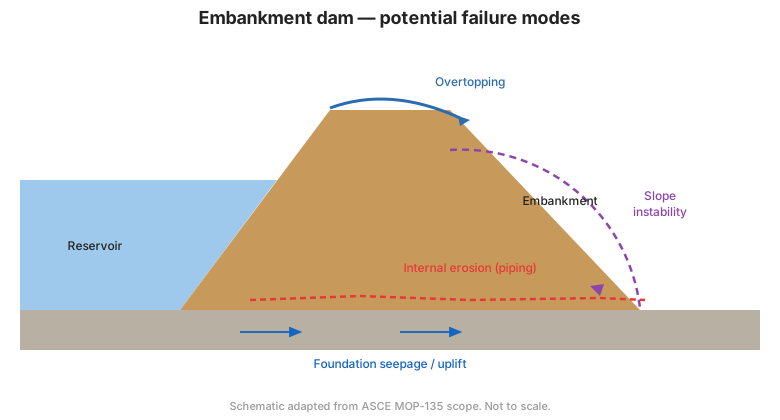
Figure. Potential failure modes of an embankment dam: overtopping, internal erosion (piping), slope instability, and foundation seepage (ASCE MOP-135 scope).
2.7 Key takeaways
- Plan monitoring from credible failure modes, not from a catalog of instruments.
- Internal erosion and slope instability dominate embankment-dam risk.
- Uplift and structural cracking matter most for concrete dams.
- Establish a baseline early; deviations from it are the signal.